


Propaganda, in its broadest sense, is a fundamental piece of understanding history. Some believe that its use is limited to authoritarian regimes, as was the case with Nazi Germany, while others believe that it is something that emerged with the great wars of the 20th century. The reality is that we have had propaganda at least since we have had mechanisms for writing down the transmission of information, as the history of the Battle of Kadesh shows.
Today’s example focuses on the United States and how propaganda was used intensively in the first half of the 20th century. Mainly, to raise awareness among the population about the international situation and the role that the United States had to play in the First and Second World Wars. All of this was accompanied by some wonderful maps that were used during that period to spread a narrative in favour of warmongering.
The aftermath of the First World War
American society did not want to enter the First World War. The conflict in distant Europe was of no tangible interest to citizens, as it had little to do with their everyday problems. The media did try to report on what was happening on the old continent, and even managed to get some events on the front page and into the conversation of the elites. In 1914, there was much talk of how Germany had decided to invade and massacre Belgium, a friendly country, in an overwhelming and inhumane manner. In 1915, the most impactful news story was the sinking of the RMS Lusitania by a German submarine, killing more than 1,200 people, including 128 Americans.
It is common to read that the sinking of the RMS Lusitania was key to the United States’ intervention in the war. However, the reality is that it took a lot for the government to get the population on its side. Propaganda in the media became increasingly evident, talking about the cruelty of the German Empire and how France and England were resisting badly in the face of pressure. But the discourse continued to fail in the basics: the war was on the other side of the Atlantic Ocean, too far away for any citizen to choose to sacrifice anything. It is in this context that, throughout 1916, more direct propaganda began to appear, such as this magnificent cover of Life magazine.

This map does speak to something that may matter to society. It speaks of a possible future in which the enemies of the United States managed to conquer the entire territory, creating the state of New Prussia and relegating US citizens to a small reservation in the state of New Mexico. The cover also suggests the possibility that Japan, as one of the United States’ main enemies, could end up taking over the entire West Coast. Entirely ignoring the fact that, if the country entered the war, both countries would be fighting on the same side.
Finally, the United States declared war on Germany in April 1917, using the Zimmermann Telegram, a communiqué leaked by British intelligence in which Germany proposed an alliance with Mexico. As public support was still very weak, the government was forced to create the Committee on Public Information, a government agency to control public opinion. In other words, it was a propaganda ministry, although Woodrow Wilson, President of the United States, repeatedly stated that it had nothing to do with the propaganda of other authoritarian states such as Germany1.
The interwar period
The Committee on Public Information remained in place until the end of the war, but had to be disbanded shortly afterwards, as the public and the media repeatedly expressed their dissatisfaction with it. In fact, this interference by the state had a profound impact on American society over the following two decades. It perpetuated a certain desire for neutrality that would keep the country away from the problems and disputes of other parts of the world. Interestingly, this quest for neutrality fought so hard for freedom of expression and against censorship that the United States soon found itself with enemies within its own territory.
All kinds of ideologies that were spreading across Europe were quickly reflected in American society. One of the most remarkable examples was the emergence of Friends of New Germany, an association affiliated with the German Nazi party. It was founded in 1933 with the aim of promoting sympathy for Adolf Hitler and Nazism as his authoritarian position was being consolidated in Europe2. At the same time, and partly in response to the spread of these ideologies, there were also many organisations and media outlets that attacked the discourse through propaganda. A notable example is the following map by Howard Burke, which appeared on the front page of the Los Angeles Examiner newspaper in November 1937.

Since the beginning of the 20th century, tension between the Empire of Japan and the United States had only grown. On the one hand, there were US interests in Asia; on the other, Japanese expansionism was taking control of China and, as a result, monopolising all commercial opportunities in the region3. In the mid-1930s, many European countries viewed Italian fascism, Soviet communism and German Nazism with suspicion, but in the United States, the real arch-enemy was Japan and the Japanese. And that is precisely what Burke’s map reflects, as it explores the multiple routes the Japanese army could take to attack the country directly.
Four years before Pearl Harbor, Burke correctly identified the base as the main target, but he failed in his subsequent predictions. He predicted the destruction of the entire Pacific fleet in the attack on Hawaii, after which he assumed that the Japanese navy would reach San Francisco via Alaska, destroying the city. At the same time, another mission would arrive from Hawaii to Los Angeles and San Diego, taking both cities and thus opening the door to a land invasion.
All this level of detail is not accidental; it is key to effective propaganda. When a message seeks to reinforce itself, it is enough to speak in vague terms, since a convinced person does not need much to perpetuate their position. On the other hand, if you want to win supporters for the cause, you require plenty of details to make the threat feel real. With pieces such as this map, or the thousands of books, newspapers, novels, comics, and films that promulgated the yellow peril4, rejection and racism against the Japanese became deeply entrenched among the citizens of the United States.
The United States’ entry into World War II
In September 1939, Germany invaded Poland, thus beginning World War II. As had happened twenty-five years earlier, the United States chose to remain neutral in the conflict. Despite growing tension and multiple propaganda campaigns from foreign agents, society still felt alien to any kind of intervention. Memories of the First World War were still fresh, and this time it was going to be much more difficult to gain the support of the population.
Even so, the government, which had so strongly promoted freedom of expression, had been operating a de facto censorship system since 1937, in collaboration with the library system. This was to identify and limit the dissemination of ideas classified as anti-democratic, such as communism or Nazism. This allowed other positions to emerge without any counterpoint as the de facto narrative in American society. Richard Edes Harrison was the cartographer who knew how to take full advantage of this position, with multiple maps that have gone down in history for their great impact, but also for their magnificent artistic quality.

This first map by Harrison was published as part of his 1940 book, Atlas For The U.S. Citizen. It shows the United States from a bird's-eye view from three different points, each simulating the possible ways in which the country could be attacked: from Berlin, with the German army entering through Newfoundland; from Tokyo, with the Japanese Empire entering via the West Coast; and from Caracas, with any enemy that had taken South America at the forefront.
The intention was clear: the world was at war, and friendly countries were suffering defeats in Europe and Asia. American citizens, to whom the atlas was addressed, had to be made aware that inaction would ultimately have consequences. And those consequences were made tangible and detailed once again on a map.

This second map by Harrison is perhaps the best known of all. It was published by Fortune magazine in 1941 and shows the world divided during the Second World War. The way the information is presented on this map is magnificent, as the polar projection modifies the perception of distance between the United States and the rest of the world. But to understand the superb propaganda weight of this map, in favour of the United States taking an active part in the war, it is critical to review the dates and content of the map.
The author uses different colours to represent the situation, but to simplify5, we will focus only on red, which shows the Allied countries, and black, which shows the Axis countries. The map was published in August 1941, but Germany had already broken the non-aggression pact with the Soviet Union after launching Operation Barbarossa in December 1940. Even so, the map still shows the USSR as if it were part of the Axis, which helps to give weight to the black colour on the map and thus increase the sense of threat and the urgency to act. On the other hand, if we look at the United States, it appears in red, as if it were already part of the Allied forces. But the attack on Pearl Harbor, and the subsequent US entry into the war, would not happen until December 1941. Harrison no longer thought about neutrality and directly showed who were the friends and who were the enemies in the war, even though the US public and government still did not want to be involved.
Finally, on 7 December, the United States entered the war, and just twelve days later, the Office of Censorship was created, which set in motion the government’s propaganda machine. A few months later, this would be complemented by the Office of War Information, established in mid-1942. In this new context, and now with the official backing of the administration, Harrison published a new version of his popular 1941 map.
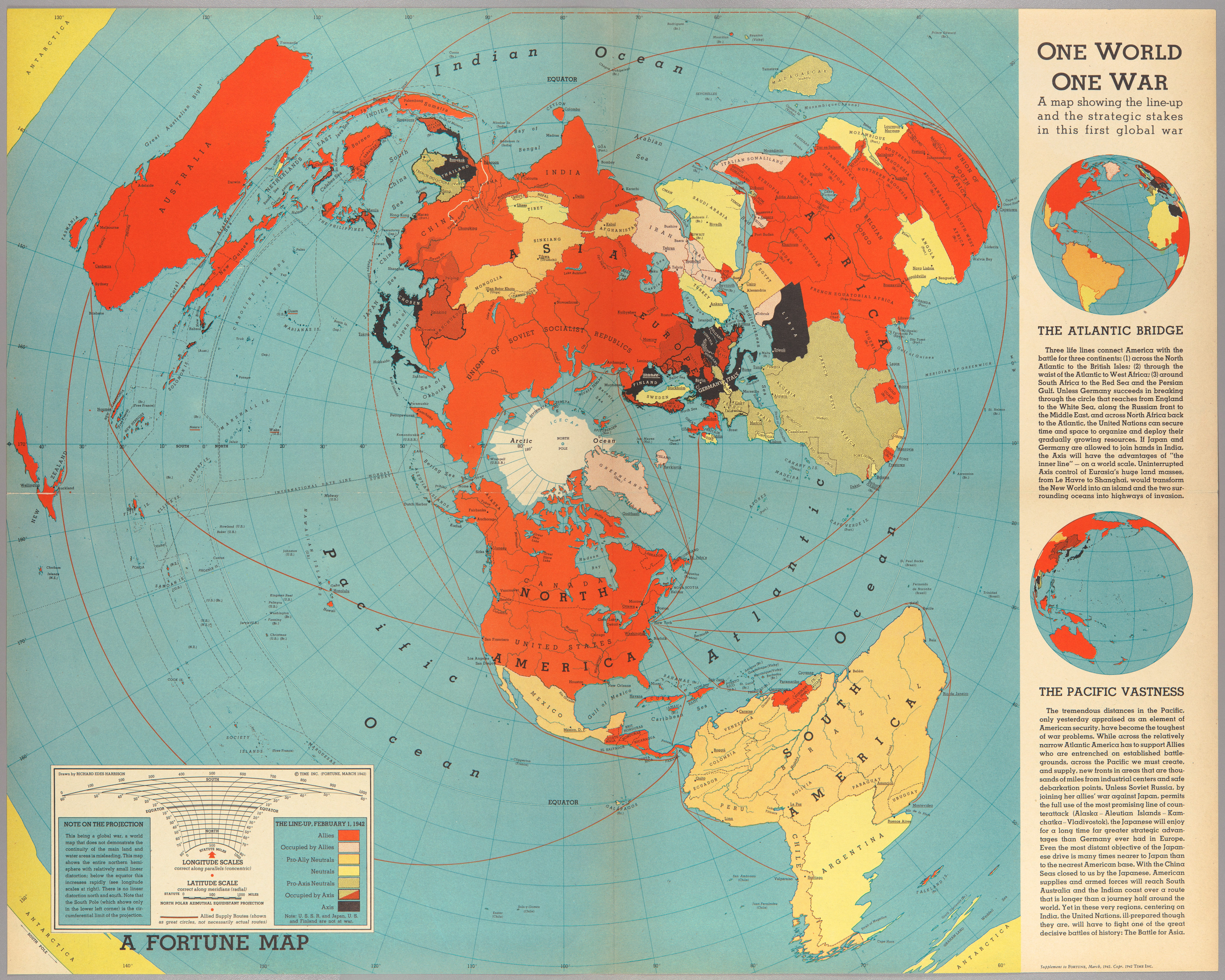
Analysing the differences between the two maps helps to understand the radical change in the message of American propaganda after the country entered the war. The first map was titled ‘A Divided World’ and made constant references to the danger and catastrophe that non-intervention could bring. The second map changes the title to ‘One World, One War,’ thus supporting the idea of unity. In turn, the colour of the Soviet Union has been corrected, and the weight of the red colour is overwhelming, which attempts to bring a halo of hope among Americans.
This was something very necessary to think that the end of the war is near and that all sacrifice would not be in vain.
By popular demand, here’s a button for procrastinating, in case you have plenty of things to do, but you don’t feel like. Each time you click on it, it will take you to a different map from the more than 1,200 in the catalogue.
If you like what you read, don’t hesitate to subscribe to receive an email with each new article that is published.
It can be said that he is partly right, since after all, propaganda in an authoritarian state and in a democratic one differs significantly in form and appearance, although not so much in substance.
The association grew to 10,000 members in the United States and gained control of some German-language newspapers. Through them, they encouraged the boycott of Jewish businesses in New York City.
This article from the US State Department’s Office of History discusses all of this in more detail.
The yellow peril is a racist metaphor that became established in the United States during the first half of the 20th century to refer to the population of East Asia and how they were a problem for the Western world.
If you would like more details about this map, you can have a look here.
Fascinating. Thank you.