


This is an easy question to ask and a fairly common one. At the same time, it is a rather difficult question to answer. Currently, with our well-defined borders, it seems surprising that there is no clear consensus on how many countries there are in the world, but the reality is that there isn’t. However, just because there is no context does not mean that we cannot talk about it and understand how we can arrive at different figures which, depending on the criteria we take into account, can be considered true.
Before we continue, would you be able to give me an estimate?1
Before we start counting, we need to define what we are going to count. Definition and terminology are a real minefield, so allow me to equate country with sovereign state, and stick to the definition established in the 1933 Montevideo Convention2:
The state as a person of international law should possess the following qualifications:
A permanent population.
A defined territory.
Government.
Capacity to enter into relations with the other states.
— Article 1 of the Montevideo Convention on the Rights and Duties of States
The idea seems simple: a defined territory, where people live permanently, and which is ruled by a government. To this, we need only add that a country must have the capacity to enter into relations with other countries… and this is where all the problems arise. International relations are extraordinarily complex, and the recognition of countries is not something that can be taken for granted.
With that in mind, let’s explore the possible answers.
How many countries are there according to the UN?
The United Nations was created with the signing of 51 sovereign states in June 1945. The aim, among other things, was to promote international cooperation and prevent another world war like the two that had devastated much of the world in the first half of the 20th century. These were the signatory countries.
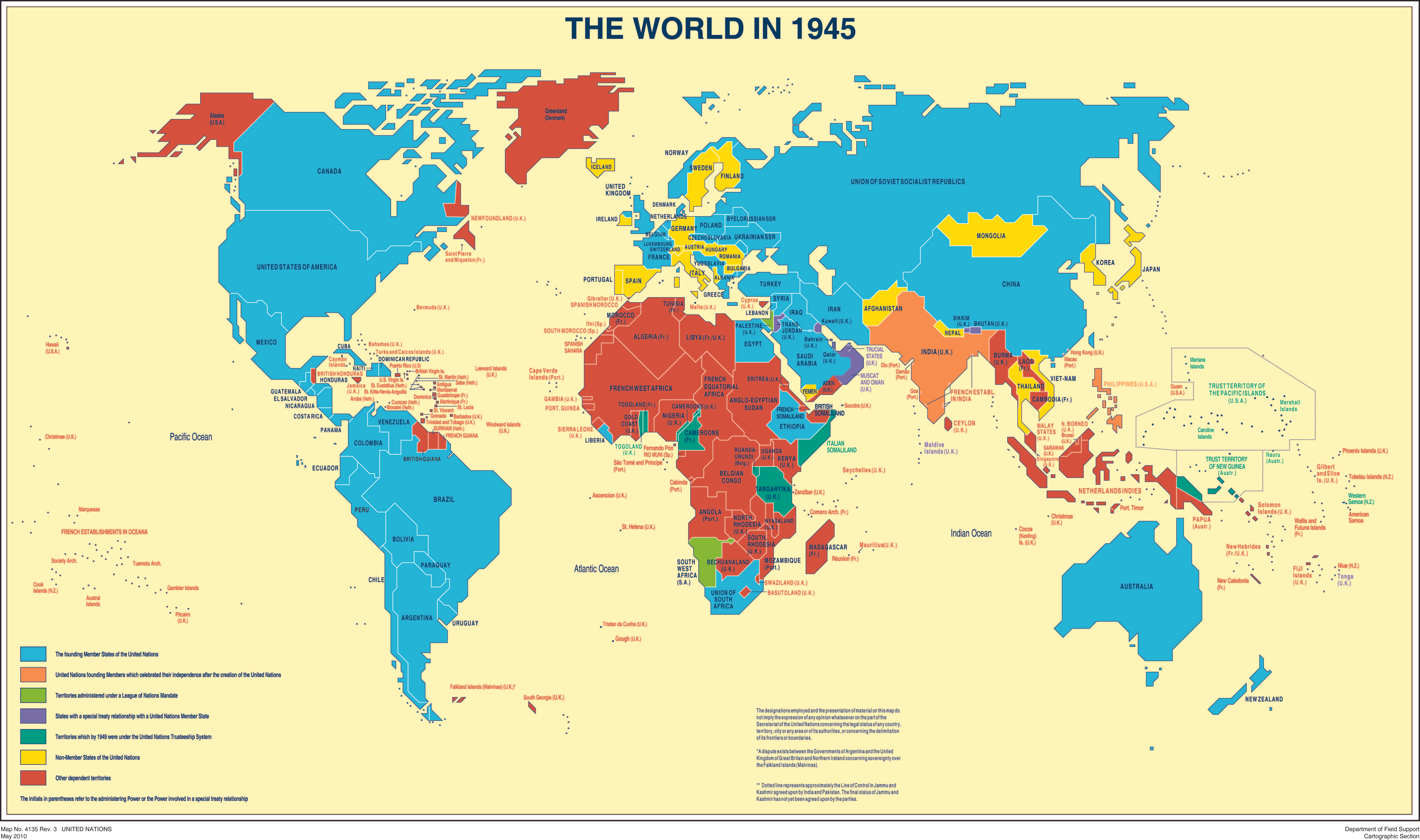
Although only 80 years have passed, the world in 1945 was very different from today’s world. In the map above, the founding members of the UN are shown in blue, including almost all of America and the Middle East, part of Europe and some countries in other parts of the world. The countries that were not initially part of the UN are shown in yellow, including the countries defeated in the Second World War and others that did not sign up for various reasons.
The other colours? Well, in one way or another, they show the territories that were still colonies or dependent on other countries. The most curious case is that of India, which was the only founding member while still a colony dependent on the United Kingdom.
However, over time, the nations that had not joined the UN at first joined. As the colonies gained their independence and this was recognised, they were also accepted as members of the supranational organisation.

There were several key moments in this expansion. In 1955, many of the European countries that had initially been left out joined. Between 1960 and 1962, most of the newly independent countries in Africa joined, bringing the total number of countries to over 100. Growth was sustained until the 1990s, when the break-up of the Soviet Union and Yugoslavia gave rise to many countries that also chose to join the United Nations.
Interestingly, Switzerland did not sign up until 2002, just a few days before East Timor. After them, only Montenegro joined in 2006 and South Sudan, the last country to declare its independence, in 2011. In total, the United Nations currently has 193 full members, so here we have our first number, although it is better to take it as an approximation.
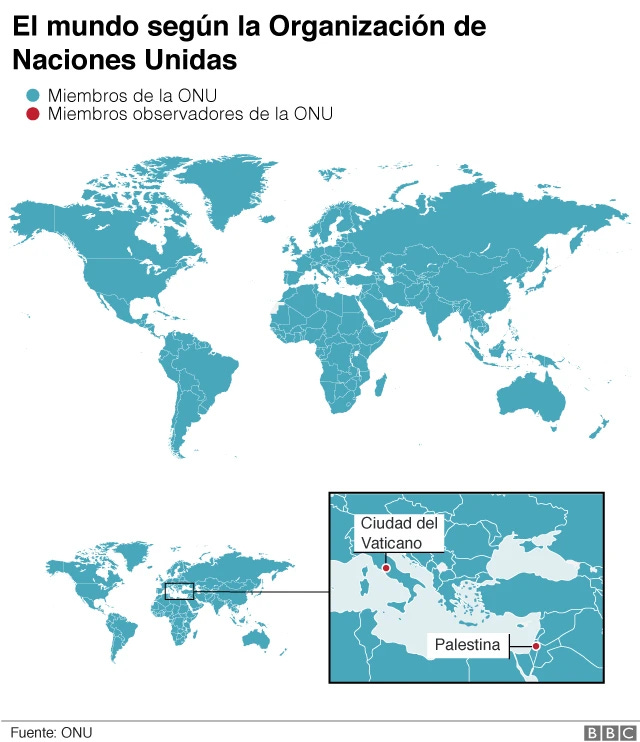
As shown on the map above, in addition to the 193 full members, the UN also has two observers, Palestine and Vatican City, bringing the number to 195 countries. If you look closely, you will also see on the map that Western Sahara and Kosovo are shown in grey. Neither is a member of the UN, despite having attempted to join the organisation, so we can raise the number to 197 countries.
The ongoing conflict between China and Taiwan is also an important consideration. Until 1971, Taiwan was a member of the United Nations, but its seat was transferred to China in the face of growing international recognition of the country, leaving Taiwan out of the organisation. Despite multiple attempts to rejoin, it has been vetoed at every turn by China, which does not detract from the fact that it is a territory with a permanent population, a government and certain international relations.
We can leave the figure at 198 for now. But since we have opened the can of worms that is international recognition, we will take a deep dive into it.
Recognition and international relations
Of the 198 countries that cover the entire territory of the planet, how many do you think enjoy international recognition by the rest of the countries? Well, only 188 are recognised by all UN members. The others lack some form of recognition:
China: 1813
Taiwan: 11
Israel: 1664
Palestine: 1575
Kosovo: 1106
Western Sahara: 467
North Korea: 191 (all except South Korea)8
South Korea: 191 (all except North Korea)
Cyprus: 191 (all except Turkey)
Armenia: 191 (all except Pakistan)9
But I love to dig into the complicated face of everything, so let’s keep going. So far, we have discussed de jure recognition, which refers to legal recognition. In other words, according to the UN, these are the countries and their international recognition, but the reality is much more complex.
If we include de facto countries, those that, although they do not enjoy international recognition, do operate as independent countries, we can add another handful of examples to the list:
Turkish Republic of Northern Cyprus, a territory belonging to Cyprus but recognised as a sovereign state by Turkey. It declared its unilateral independence with the support of Turkey on 15 November 1983.
South Ossetia, a territory belonging to Georgia, is internationally recognised by five UN members, including Russia, Nicaragua, and Venezuela. It declared its independence unilaterally on 8 November 1991.
Abkhazia, a territory belonging to Georgia, internationally recognised by five UN members, including Russia, Nicaragua, and Venezuela. It declared its independence after the end of the Abkhazian War in 1993.
Transnistria, a territory belonging to Moldova, not recognised by any UN member, but recognised by other countries such as South Ossetia and Abkhazia. It declared its independence unilaterally on 2 September 1990.
Republic of Artsakh, a territory belonging to Azerbaijan, not recognised by any UN member state, but recognised by other countries such as South Ossetia and Abkhazia. It declared its independence unilaterally on 6 January 1992.
Somaliland, a territory belonging to Somalia, recently gained international recognition from one UN country, Israel10. It unilaterally declared its independence on 18 May 199111.
![r/MapPorn - Map of States with Limited Recognition [2000 x 1200]](https://substackcdn.com/image/fetch/$s_!J8hf!,f_auto,q_auto:good,fl_progressive:steep/https%3A%2F%2Fsubstack-post-media.s3.amazonaws.com%2Fpublic%2Fimages%2F30bd0b4b-22f1-4326-9928-0e4f2e8d5a06_2000x1200.jpeg "r/MapPorn - Map of States with Limited Recognition [2000 x 1200]")
With these six countries, we can bring the total up to 204, but we can go even further. There are many countries that operate de facto independently, even though they do not openly declare their interest in being considered independent countries. This group includes Rojava, the Wa State, the Gaza Strip, Bougainville and Puntland.
The matter can become even more complicated if we begin to investigate the territorial integrity of different countries and how some autonomous regions enjoy different levels of independence. We have extreme examples, such as the Cook Islands and Niue, two territories belonging to New Zealand, but which have independent international relations with dozens of UN countries and are even full members of UNESCO or the World Health Organisation.
If we look at international organisations with less political weight, such as the International Federation of Association Football (FIFA), we also find constituent countries of states. These include the constituent countries of the United Kingdom (Wales, England, Scotland, and Northern Ireland) and Denmark (Denmark, Greenland, and the Faroe Islands), but we also find the associated or overseas territories of the United Kingdom, the Netherlands, France, and the United States.
Considering the different levels of independence and autonomous participation in international organisations, we can consider some 60 more territories with defined borders, a stable population, a government, and some level of international relations.
Adding it all up, we can go from 198 countries to about 270. And all this without mentioning the independence movements with varying degrees of support that are spread throughout the world, since in those cases, we cannot say that they have a stable population and territory.
One last twist? There is also the idea of micronations, which are countries constituted on a minimal, or even imaginary, territory, with a small population and without any recognition by other states. The most iconic example of this type of country is possibly Sealand, but if we look, we can find another 50 examples.
So how many countries, then?
As you probably know by now, there is no single correct answer. But if we go back to the survey at the beginning, we can say with some level of certainty that the most widely accepted number is between 180 and 220.
Now that we are on the subject, to keep you entertained for a while, I’m going to leave here the link to a game to see how good you are at naming the 197 countries11. You’ll have to do it in 15 minutes, which is more than enough time if you have them all memorised.
Once you've taken the quiz, let me know how you did.
Since this is about maps, I’ll also leave you with a list of the 198 countries and the maps you can find for each one in the catalogue. Because yes, I’ve managed to get at least one map for each of those countries.
By popular demand, here’s a button for procrastinating, in case you have plenty of things to do, but you don’t feel like. Each time you click on it, it will take you to a different map from the more than 1,100 in the catalogue.
If you like what you read, don’t hesitate to subscribe to receive an email with each new article that is published.
You can be honest and answer before reading further; I can’t see what you’ve answered. And even if I knew, I wouldn’t tell you anything. As long as you weren’t wrong, of course.
The 1933 Montevideo Convention was the seventh International Conference of American States.
All except the following: Belize, Guatemala, Haiti, Paraguay, Saint Kitts and Nevis, Saint Lucia, Saint Vincent and the Grenadines, Eswatini, Marshall Islands, Palau and Tuvalu. These are precisely the countries that recognise Taiwan.
It is recognised by almost all members, except for most Arab and Muslim countries.
Almost all countries in the world recognise Palestine, except for parts of Europe, North America and Oceania.
Much of Europe and North America, as well as many countries in North Africa and the Middle East.
Decades ago, recognition reached up to 84 UN members, although recently many countries have frozen their relations with Western Sahara.
Despite being recognised by all members except South Korea, it only maintains bilateral relations with 157 UN members.
Pakistan’s lack of recognition is related to the conflict between Armenia and Azerbaijan.
It is worth investigating the reasons why this has happened so late. Here is an article about it.
The 198 countries named before, except the Western Sahara, which has not been included in the quiz.