


For the past couple of years, tensions between Canada and the United States have done nothing but escalate. Things began to turn ugly when Donald Trump suggested to Justin Trudeau, during a private meeting in late 2024, that Canada might become the 51st State of the Union. Trump posted that very idea on his social media platform in early 2025, and he has not let the topic rest since. What is more, less than a week ago he reiterated this idea, referring to Mark Carney, Canada’s Prime Minister, as Canada’s next governor1.
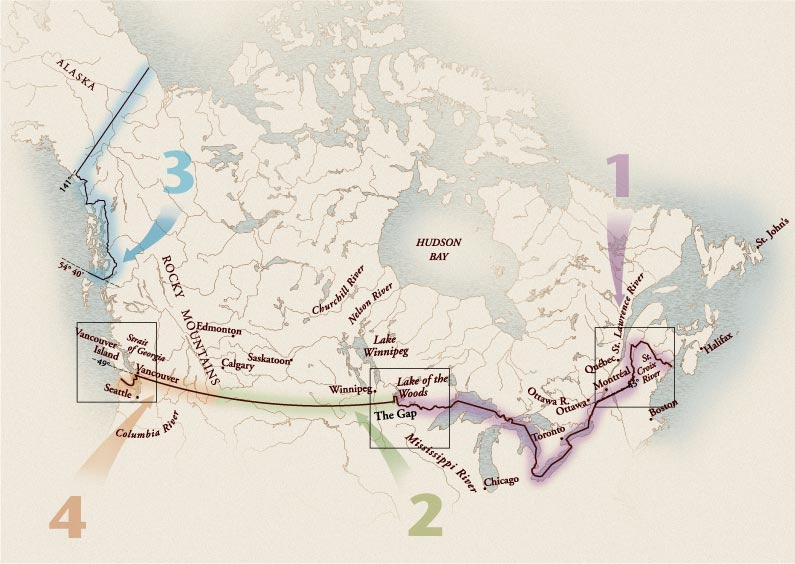
These recent tensions seemed almost impossible just a few years ago. The United States and Canada had been collaborating constructively for decades without their 9,000-kilometre shared border causing any tensions2, but this is a relatively recent development. There were clashes between Canada and the United States, and Canadian troops even went so far as to capture Washington and burn down the White House3. But perhaps it would be more appropriate to speak of a confrontation between the British Empire and the United States, since at that time Canada was still a British colony.
Canada’s path to independence was slow and gradual. It stretched from 1867, when the Dominion of Canada was established with a degree of self-government, to the signing of the Statute of Westminster in 1931. Throughout this process, the threat of a new open conflict between the United States and Canada never entirely disappeared.
The Red Plan
The United States did not play a crucial role in the First World War. The conflict had broken out in Europe and, although it had spread to virtually every continent, American involvement was difficult to justify, particularly to its own citizens. This meant that, although the United States did eventually enter the war in 1917, the British Empire emerged as the true victor, emerging from the conflict strengthened: it annexed the German colonies and remained the world’s leading naval and commercial power.
This latent threat led the United States to work on a plan known as the Joint Army and Navy Basic War Plan Red, popularly known as the Red Plan. It was a detailed plan to confront the British Empire, in which Canada, designated by the colour crimson, was considered the main theatre of military operations, given its strategic proximity to the United States.
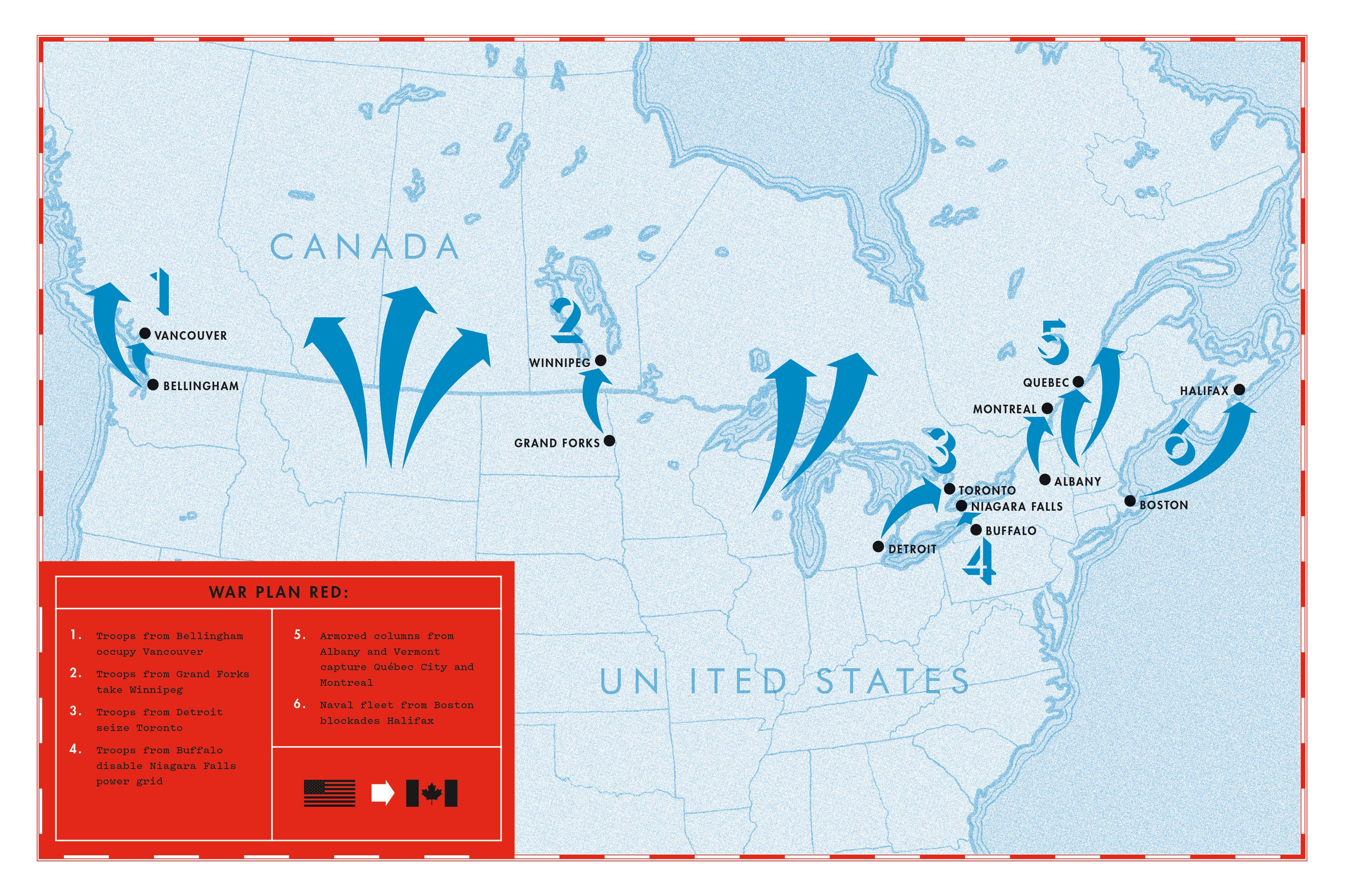
The plan was first approved in 1930 and subsequently updated in 1935. As official US Army documents4 show, the plan was specific. As a starting point, it envisaged blockading the port of Halifax to prevent British reinforcements from landing via the Atlantic Ocean. Next, a column from Detroit and another from Albany would take control of Toronto and Montreal, respectively. Simultaneously, two other columns would seek to occupy Winnipeg and Vancouver.
Alongside the capture of the major cities, the plan also envisaged disabling the Niagara Falls power station, as well as other weak points that had been identified during the secret missions carried out by Charles Lindbergh5. Perhaps the most controversial aspect of the Red Plan was that Lindbergh himself recommended the use of chemical weapons at certain points in Hudson Bay.
The Red Plan also included a significant risk assessment exercise. It expressly warned of the power of the mounted police, which could not be minimized, as well as the importance of the Halifax blockade before more than 2.5 million British soldiers arrived to reinforce Canadian positions. Furthermore, it placed great emphasis on the fact that the British were known for not surrendering easily, so any implementation of the plan had to consider a fight to the bitter end.
This plan on its own might seem somewhat paranoid, but the reality is that the First World War had taken its toll and highlighted the risks of a confrontation with any other world power. The Red Plan was just one of many plans designated by colour codes to ensure preparedness for any possible circumstance.
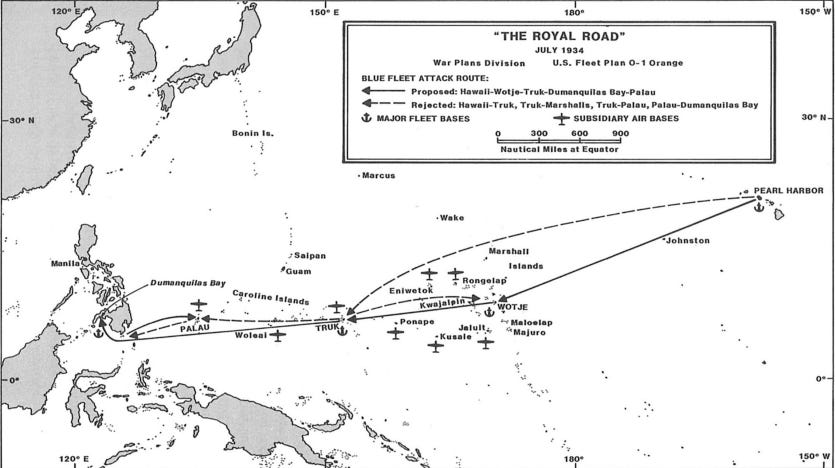
In all the plans, the United States was always assigned the colour blue, whilst the other colours were used for the other powers. The Black Plan carried great weight, as it had to be refined as early as during the First World War, if Germany emerged victorious and was able to occupy positions close to the United States in the Caribbean. The most developed of all was the Orange Plan, which defined the strategy for war against Japan, and was partially implemented during the Second World War in the Pacific Ocean. The Indigo Plan, which assessed the occupation of Iceland, was fully implemented in 1941, although it was carried out solely to limit the advance of Nazi Germany and not to fight against the Icelanders.
The existing plans covered almost every possible scenario: Plan Grey considered action in the Caribbean and the Azores; Plan Gold, an open naval conflict against France; Plan Green described an attack on Mexico. There was even a White Plan that did not target any other power, but instead considered the possibility of an internal uprising on US soil. This plan was also partially implemented following the 1932 encampment of war veterans in Washington demanding their pay, during the Great Depression.
That said, despite all this preparatory work, the United States was not the only country prepared.
Defence Scheme No. 1: the Canadian response
North of the 49th parallel, Canada had also done its homework. Independence from the British Empire not only entailed the freedom to make its own decisions, but also came with the responsibility of being able to defend its territory once the British umbrella was no longer in place.
It was in this context that Defence Scheme No. 1 was born, a plan developed by Lieutenant Colonel James Brown, a war veteran who held the post of Director of Operations and Intelligence in the Canadian Army. Before making any theoretical assumptions, Brown took a camera and drove along part of the eastern border with the United States to better understand how border relations worked. His notes covered the terrain, but also described in detail the types of towns and inhabitants on the other side of the border.
With all the information gathered, alongside intelligence reports compiled over the years, Brown drew up a plan in 1921, almost a decade before the United States considered Canada an enemy worthy of a contingency plan.
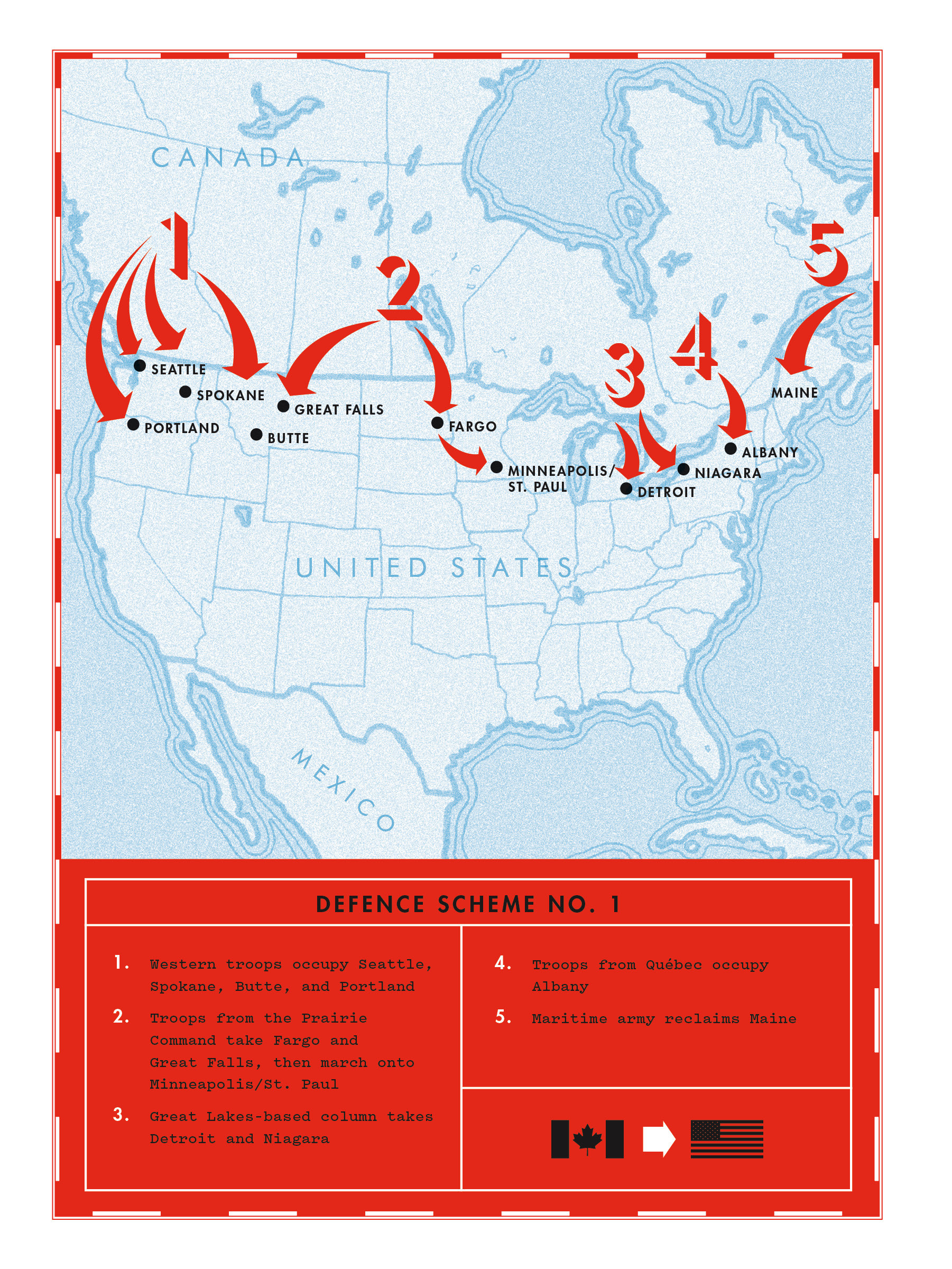
Canada’s defence plan followed the logic of someone who knows they cannot win. Its army was insignificant compared to the US military, and its industry was too exposed just a few kilometres from the border. This made it essential to hold out against the initial onslaught long enough for support to arrive from other Commonwealth countries. And, as the saying goes, the best defence is a good offence.
Brown’s solution envisaged launching five simultaneous attacks on Portland, Fargo, Niagara Falls6, Albany and the state of Maine. These five attacks were intended to be dynamic in nature and were in no way intended to seize control of any city. Brown knew it was impossible to fight the US army head-on, but he could attempt to divide its forces so that it would take them longer to organise a ground invasion. Once the enemy army had deployed at each of these five points, Canadian troops would begin their withdrawal, ensuring that all bridges, railways, and means of transport were destroyed.
The plan was pushed aside in 1928, two years before the United States devised its Red Plan to invade Canada. The Chief of the General Staff, Andrew McNaughton, considered it dangerous to have such a plan to defend against an ally, as, if the strategy were exposed, it could cause a diplomatic crisis that would be difficult to manage.
The documents containing the details were burned, and only fragments were preserved. The only reason this plan came to light was because the United States declassified its Red Plan. This gave Canada the freedom to show that it had already devised a response even before the United States had even considered the possibility of attacking.
Epilogue
Reading these two plans today sends a shiver down the spine. The UN, NATO, the European Union and other supranational organisations were created to foster international cooperation and joint defence, but also as a mechanism to limit friction between neighbouring countries. In the West, we have spent decades growing accustomed to a non-aggression pact that made the need for such plans unthinkable, but reality has proven far more treacherous than we believed.
Having plans for everything, including the impossible, was not a strategy unique to Canada or the United States, but rather a common practice of any modern state. These plans do not speak of the likelihood of something happening, but of the need to be prepared so that surprise does not catch you off guard. In most cases, and certainly in the case of Plan Red and Defence Scheme No. 1, these contingency plans did not have the approval of heads of state. They were just internal military strategies in case it became necessary to implement them at some point.
These plans surely never disappeared completely; they were simply adapted to new circumstances. And, possibly, in past months these plans have been changing and adapting rapidly to the current times.
By popular demand, here’s a button for procrastinating, in case you have plenty of things to do, but you don’t feel like. Each time you click on it, it will take you to a different map from the more than 1,200 in the catalogue.
If you like what you read, don’t hesitate to subscribe to receive an email with each new article that is published.
These were his statements just five days ago, on 10 March.
As a curious detail, Canada and the United States are the two countries that share the longest border in the world, as I have already mentioned here.
Not just the White House; they burned almost all of Washington.
Plan Red remained secret until it was declassified in 1974.
In the 1920s, Lindbergh was one of the most celebrated heroes of American aviation. Years later, several of his articles on racial superiority and eugenics brought him closer to Nazi views, although this is something he always denied.
There are two towns called Niagara Falls, one on each side of the border. The reason the plan aimed to capture the US Niagara Falls was to protect the power generated by the Niagara Falls power station.