


Have you ever wondered how long Britain’s coastline is?
Off the top of your head, it’s surely something you can look up in any encyclopaedia, just as you might find the country’s area, the highest point or capital. If you look in The World Factbook1, you’ll find that the total length of the United Kingdom’s coastline is 12,429 kilometres. Perfect, we have a figure.
Except it’s not really that simple, it’s all much more complicated than it seems.
Lewis Fry Richardson’s discovery
Lewis Fry Richardson was a highly versatile academic. He conducted research in fields as diverse as mathematics, physics and psychology, and was also a committed pacifist. Richardson believed that through applied mathematics and physics, patterns could be found in the workings of the world, enabling us to understand all kinds of disasters and, in that way, find ways to prevent them. Somehow, this way of thinking explains the motivation that led him to study meteorology and eventually create one of the first models for forecasting the weather.
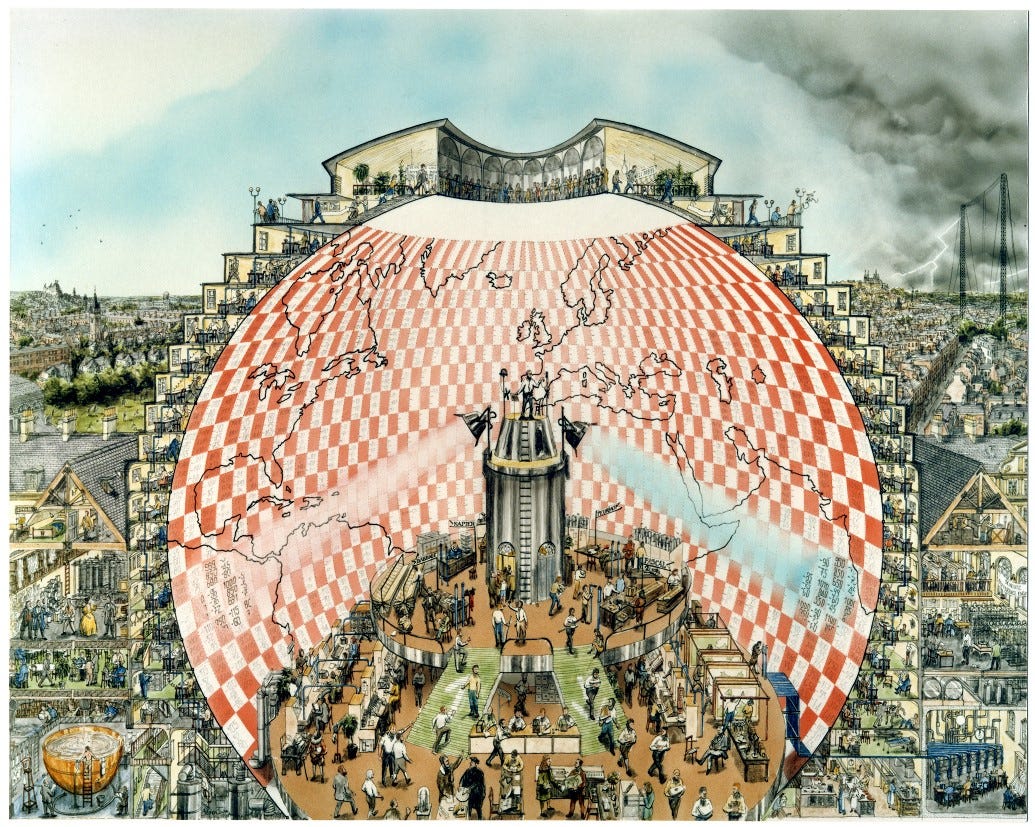
These concerns led him to attempt to understand whether there was any relationship between the probability of two countries going to war and the length of their shared border. Whilst compiling data, he found that different sources provided conflicting figures. For example, Spain estimated that its border with Portugal was 1,214 kilometres long, while Portugal, for its part, claimed it was only 987 kilometres. It might have been nothing more than a curiosity, but when he looked up the length of the border between the Netherlands and Belgium, he also found two different figures: 380 and 449 kilometres.
These discrepancies came as a surprise to Richardson, but he soon stumbled upon an explanation: it all depended on how the border was measured. If a large ruler were used, many details would inevitably be missed and the total distance would be shorter. Conversely, with a smaller ruler, it was possible to cover more nooks and crannies and thus arrive at a greater total distance.
To illustrate this, I have measured the length of the border between Belgium and the Netherlands on Google Maps using segments of different sizes. Using only 20-kilometre segments, the approximate distance is 259 kilometres. If, instead, we use 10-kilometre segments, the final distance is 315 kilometres. A greater distance in the second case, but in both instances much shorter than the official distances Richardson encountered. Undoubtedly, this is because the measurements used a ruler much smaller than 10 kilometres.


His findings were published posthumously in 1961 in The problem of contiguity: An appendix to Statistics of Deadly Quarrels2, and extrapolated the problem to the coastlines that define a country. In his study, he demonstrated something that, at first glance, may seem counterintuitive: as the size of the ruler used for measurement decreases, the length of the coastline increases without limit. This is known as the Richardson effect3.
Mandelbrot and the coastline of Great Britain
Borders between two countries are, ultimately, lines agreed upon by the two countries forming that border. This means that the intricacies are limited and, ultimately, a consensus can be reached. Coastlines, on the other hand, are the result of millions of years of tectonic plate movements and the action of the elements; the inlets and outcrops are complex and of sizes that can be several orders of magnitude smaller than the total length of the coastline.
Benoît Mandelbrot came across Richardson’s article and decided to investigate the mathematical problem of coastlines, publishing his findings in his 1967 paper entitled How Long Is the Coast of Britain? Statistical Self-Similarity and Fractional Dimension4. At the conference where it was presented, Mandelbrot asked his colleagues about the length of the coastline of Great Britain. Some gave a rough estimate, others referred to encyclopaedic data, but none came up with the answer Mandelbrot expected: infinite.
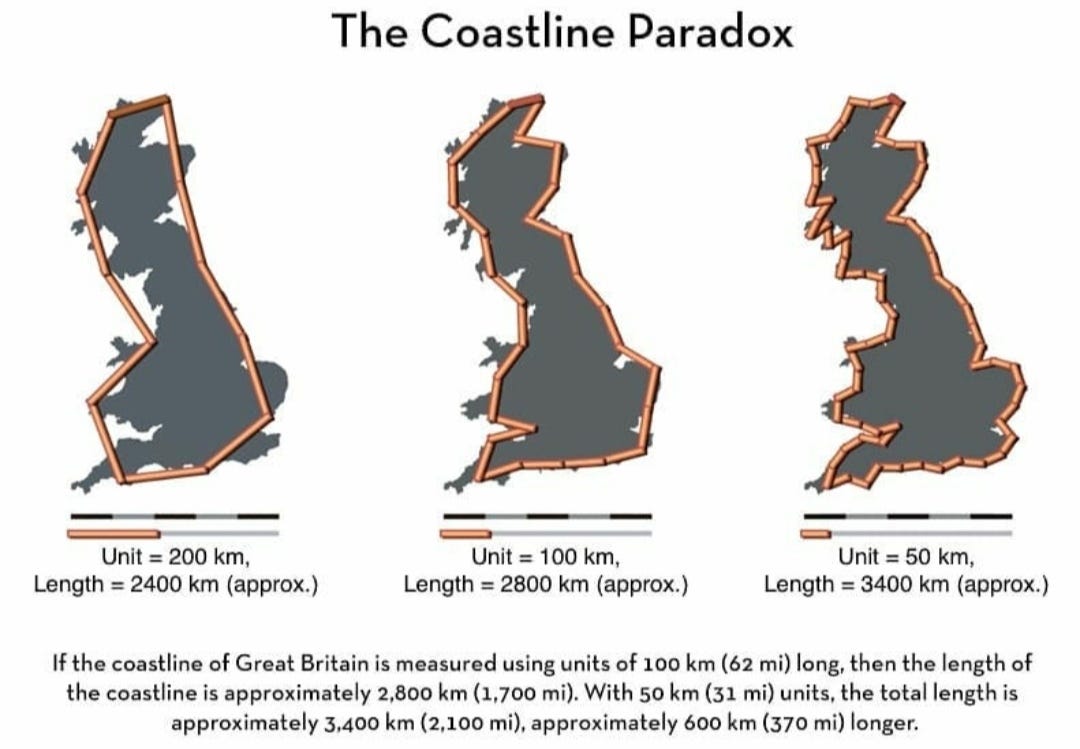
When surveyors set out to measure the length of a coastline, they use a tape measure or a ruler of defined length. Let us say they use straight sections of 200 kilometres to measure the coastline of the British Isles. The result they obtain will be approximately 2,400 kilometres, as shown in the image above. Anyone can see that this approximation is crude and far too imprecise. So it would be better to take a shorter straight measurement segment, 50 kilometres, for example. In this case, the result of measuring the coastline’s length will be greater than in the previous case: 3,400 kilometres. The explanation is simple, as we have now had the opportunity to measure bends that had previously been completely overlooked.
But is this approximation sufficient? As the following animation shows, clearly not.
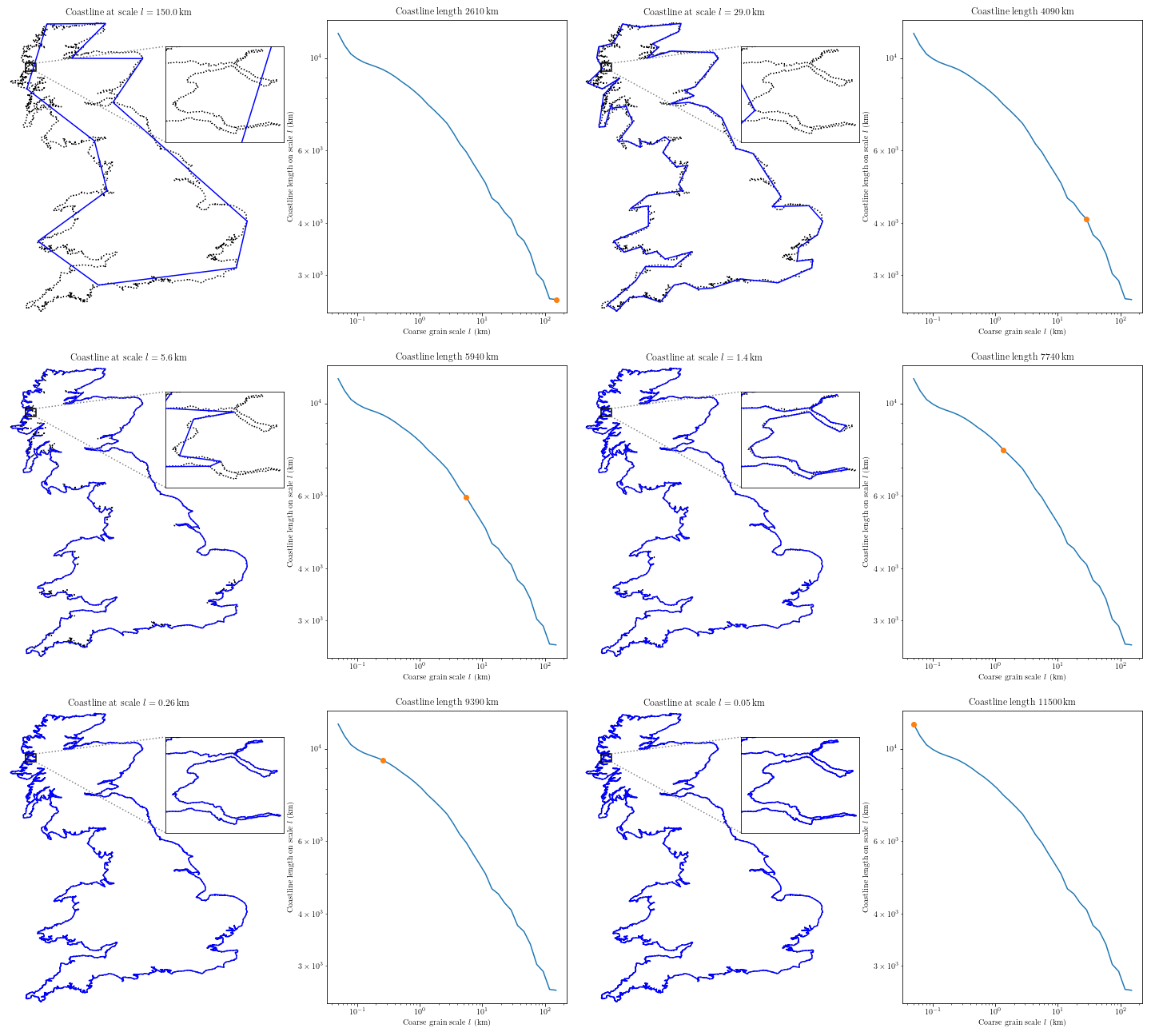

When the measurement segment is reduced to 100 metres, the total length we find is 17,820 kilometres, almost five times greater than when the reference measurement is 50 kilometres.
Returning to the two encyclopaedic figures we cited as references at the start, we find that The World Factbook gives the total for the United Kingdom, including Great Britain, Northern Ireland and all the smaller islands, a coastline of 12,429 kilometres, whilst the World Resources Institute puts it at 19,717 kilometres. With these figures in hand, we can infer that the resolution of at least one measurement is, with almost complete certainty, better than 100 metres.
Next time someone tells you how long a country's coastline is, ask them how long their ruler was. Chances are they won't know. And if they did know, you can always challenge that it was not small enough to be accurate.
After all, the only perfectly accurate answer is infinite.
By popular demand, here’s a button for procrastinating, in case you have plenty of things to do, but you don’t feel like doing any of them. Each time you click on it, it will take you to a different map from the more than 1,200 in the catalogue.
If you like what you read, don’t hesitate to subscribe to receive an email with each new article that is published.
The World Factbook was an annual publication by the CIA containing data on every country in the world. It was discontinued at the beginning of 2026, but at least there are multiple websites that have archived all its content, like this one.
This statement was made regarding coastlines, not borders. I’ll explain this a little later.
I respectfully submit that Mandelbrot probably did not really expect infinity. That might be the answer for a mathematical fractal, but for a physical thing such as an island, the fractal self-similarity breaks down when you get down the scale of individual atoms (or before that). A completely separate issue is that the length of a coastline cannot even *have* a definite value, even in principle. Say you define the coast as the outer-most point with an altitude of the mean sea level at that point. Every time a grain of sand shifts by a fraction of an angstrom, which is constantly, the length of the "coastline" changes. One cannot measure something with a greater precision than the thing possesses. Of course the 'coast' used to define territorial waters and economic zones is merely defined by official charts with special rules for islands and inlets and such.
This is my physicist's take on it. It is a classic measurement problem.
The problem is one of definition - in defining a perimeter you need to include time, physical constraints and precision. Time is the most tricky: sea level varies continuously so the precision can never be better that the precision of the sea level measurement. There is constant erosion and deposition, but that is probably handleable at a precision of 1 month. The physical constraint is that what is land or sea is not clear cut - you need to make a decision. These impose a limit on the precision that could ever be obtained. Forget about atom by atom, just consider that a you need a way to decide whether each grain of sand is in or out. What is certain is that physical and temporal constraints make the length measurable to a precision determined by the way in which it is measured. 1m precision would probably mean measuring all points along the sea edge simultaneously within a 10 minute interval.
And back to the post, which is not about reality, rather about human perception. . The question is, what is the length as measured on a map. The map is a real object and the border length can be measured to the precision at which the map is printed. But obviously there is not just one map. Choose a different map and you will get a different answer. Each individual map however does deliver a precise finite answer, demonstrating that they are artifacts which we have created