


Today’s topic may be a sensitive one, so I will use this introduction to lay some groundwork that will help contextualise what follows.
Schools and educational models are what enable us to regulate the knowledge that every citizen needs to coexist and successfully serve the society of which they are a part. At its most fundamental level, this is how children learn to read, write and grasp basic mathematical concepts. All systems include various subjects that present pupils with knowledge in other fields such as biology, physics, chemistry or foreign languages. Beyond that, there are also subjects that help them understand cultural traditions, history or the administrative and political foundations of the state of which they are a part of. It is important that all this is taught from a young age, as the great plasticity of young people allows these foundations to become firmly rooted in the individual. And it is precisely this last point that makes education such a magnet for propaganda.
This leads us to a major debate. Where does education end and propaganda begin? Of everything taught to a child, what is acceptable to society and what is not? The debate over the distinction between education and propaganda is one that has been going on for over a century in academic circles, and perhaps many centuries longer in conversations among citizens. People are uncomfortable with the possibility that schools might be indoctrinating their children with ideas or values that do not align with their own. In fact, it is a recurring topic of conversation whenever there is an educational reform, as there is always a fear that schools might be used as a platform for indoctrination, whether by teachers with a personal agenda or out of self-interest and under the direction of those in government.
The question has no answer, or at least no obvious, consensus-based answer1. It is easy to fall into simplistic arguments, such as the notion that education focuses on what is true, whilst propaganda seeks to distort that truth. If this were the case, who would determine what is true and what is false? It may be easy to reach agreement in mathematics and even in some sciences, but it would prove far more complicated when we delve into history or the values of society.
With that dilemma, I will now turn to today’s topic: educational propaganda in Imperial Japan.
The Meiji Restoration and Gakusei
The history of Japan is the history of an isolationist nation, at least before the first arrival of the West. From that point on, it did not take long for a series of restrictions on international relations to be established, which were enshrined in the sakoku policy. This completely prohibited anyone from entering or leaving the country, with contact limited to Korea, China, and the Netherlands, its sole trading partner in the West. Following a civil war, the Meiji Restoration arrived in 1868 and, with it, the transition to modernity.


The Meiji Restoration can be understood as a set of changes that transformed Japan from a medieval society into a modern state, like the many that emerged across the world between the 18th and 19th centuries. Among the many reforms, society was restructured, eradicating the complex class system to simplify it into just two classes: one comprising the privileged groups, such as aristocrats and samurai, and another for the rest of the population, including farmers, artisans, and merchants. More significant was the economic reform, which centred on the industrialisation of the country; to achieve this, it was necessary to open the borders and begin exchanging knowledge with foreign powers.
On 3 August 1872, just four years after Emperor Meiji came to power, the first national education plan, known as Gakusei, was announced. For all the reforms being implemented to have a lasting impact, education had to reach all sectors of society, as until then, it had been limited to the samurai, focusing exclusively on calligraphy, the use of the abacus and the study of Confucian classics. Heavily influenced by Western education systems, Gakusei brought primary education to all the country’s young people, expanding the subjects taught to include reading, writing, public speaking, history, geography, science, arithmetic, health, and ethics.
One of the main problems encountered by this reform was the lack of books and resources to cover the new curriculum. Initially, the decision was made to repurpose all existing material and import books from the West, which could be used to cover the new subjects. The lack of planning meant that the subjects and their content were not age-appropriate for the pupils, so the Ministry of Education soon had to change its strategy and begin creating its own materials. In geography, two of the earliest examples can be found in these two maps produced by the cartographer Shūichi Miyake in 1876 to depict Asia and Africa.


These two maps are particularly interesting, as they clearly illustrate Japan’s isolation up to that point. The maps show territories on each continent, but only consider part of the political reality of these regions. The fact is that this was not yet of interest to a country that was just beginning to open up; it was sufficient for school pupils to become familiar with the idea that the world was a place far beyond the archipelago, that these lands could be divided into a series of regions, and that within these there were some important states.
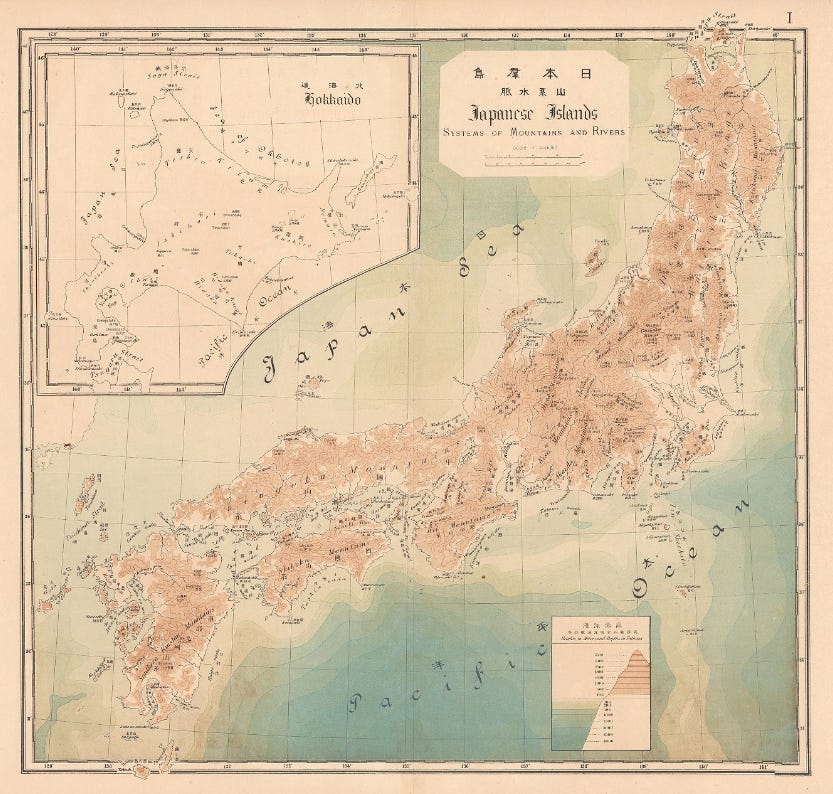
In the same lines, other more elaborate works soon appeared, which were necessary for studying specific subjects within the Japanese context. In 1885, Japan’s first thematic atlas, Agricultural Production of the Empire of Japan2, was published. Although its primary purpose was to provide data on Japan’s agricultural system, it offered a high level of detail on the country’s geography and geology. This atlas, like much of the material produced during this period, was written in both English and Japanese so that it could be used to exchange information and continue to receive material from other countries.
Propaganda for the new education system
In 1895, the Empire of Japan began its expansionist period, with the first wars in which it faced China and Russia. This new character gradually impacted the education system, which began to transmit a series of precepts designed to ensure that Japanese citizens shared the Emperor’s and the Japanese government’s worldview.
Within the subjects devoted primarily to ethics, public speaking and history, the Kokutai was promulgated, Japan’s particular way of understanding the national essence. Unlike many European states, such as France, in the Empire of Japan national identity does not emerge from the people, but flows from the divine status of the Emperor, as a direct descendant of Jinmu Tennō3. But what is perhaps most curious is that this Japanese nationalism with spiritual roots does not reinforce the importance of religion within the state or the society, but merely uses the leader’s divinity and spirituality to legitimise his position in power. Furthermore, all students were considered children of the Emperor, and they were expected to sacrifice themselves, if necessary, to serve the nation.


To reinforce the idea of superiority in the youngest children, the Ministry of Education also made use of other scientific subjects. The best example is the theory of evolution, which clashed head-on with Japan’s religious and cultural traditions, yet became part of the school curriculum. The reason was not a conviction that Darwin was correct, but rather that it was used as a necessary tool to explore the superiority of the Japanese people from a different perspective. Much like what occurred in Nazi Germany, the theory of evolution also came to be used to justify eugenics as a legitimate means of maintaining the power of the Empire of Japan4.
As part of the education system, the teachers, and lecturers delivering the lessons were also key figures. Government associations were established, in which all education professionals were obliged to participate. The aim was to ensure a constant level of peer pressure, making it easy to identify non-compliant individuals and ensuring that all were compelled to teach in accordance with the guidelines set by the State. These associations involved the Army, which had the authority to supervise lessons. Intervention was rarely necessary, as the mere threat proved sufficient to maintain consistency among the teaching staff.
Once the Second World War had broken out, the need for propaganda to secure the support of the younger generation increased. The Government was aware that it could not conceal its expansionist agenda, so all the work in schools was supplemented by a series of magazines that highlighted the Army’s sacrifices for the good of Japanese society. Throughout 1940, several issues of a magazine entitled Comrades and Students at the Front were published, recounting the exploits of the youngest members of the Army as proof that every member of society could make a difference. This magazine was also accompanied by numerous maps illustrating the advances of the Empire of Japan.
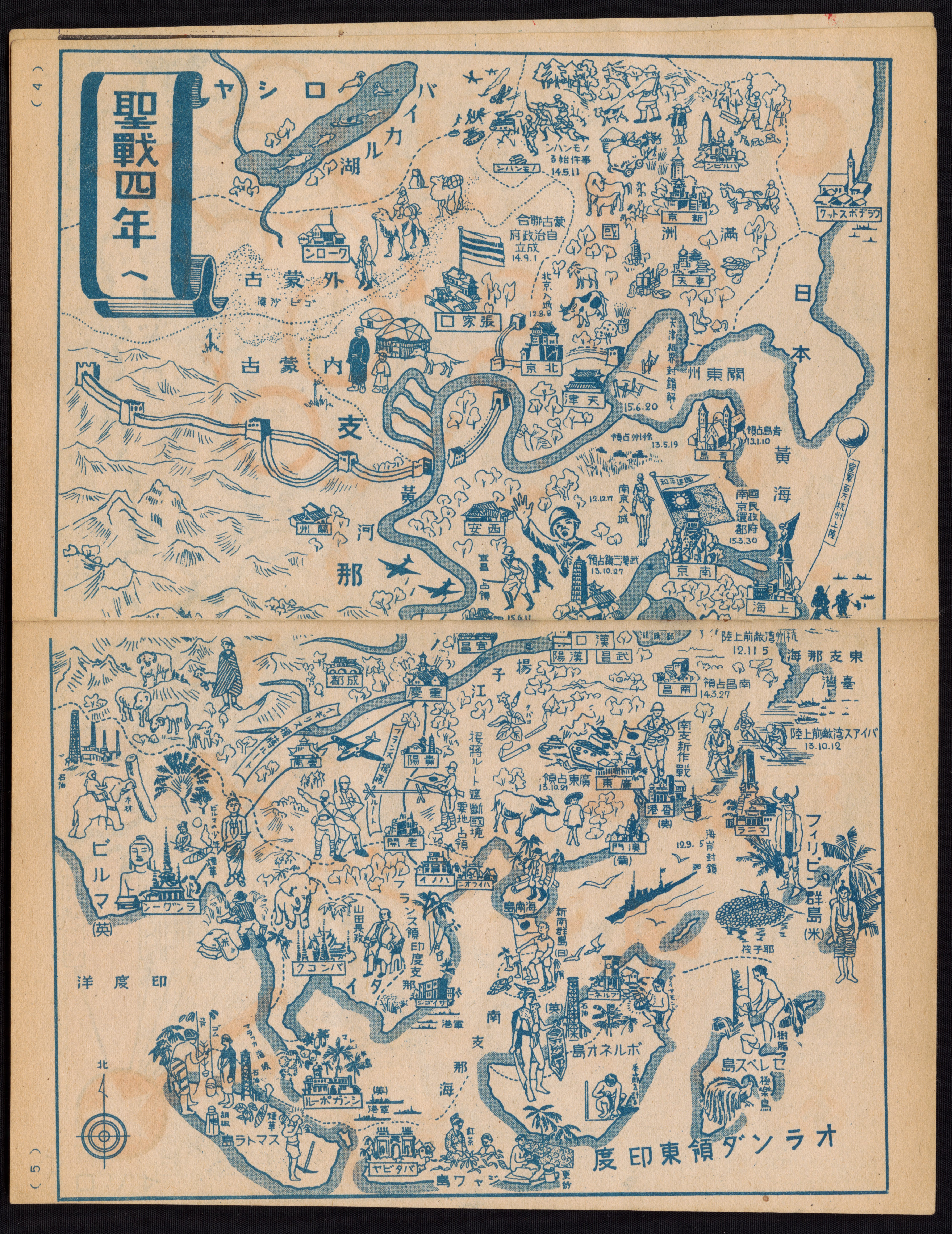


Through this magazine, the government ensured that students were aware of what was happening in the world, and it enabled teachers to adapt their teaching to include references to the new enemies and the reasons why the Japanese Empire’s actions in the Pacific and Asia were justified.
Education beyond schools
Unlike in other countries, like the Soviet Union, the United Kingdom or Germany, youth organisations were of little significance in Japan. The only example of this was the creation of the Greater Japan Youth Party in 1937, inspired by the Hitler Youth, but two years after its creation it had barely reached 2,000 members. Without organisations to occupy children’s spare time, how did the Japanese government ensure that the narrative would also prevail outside school hours? The answer lies in something as characteristic of Japan as manga.
Seeking a context detached from a purely educational nature, many publishers in Japan began to publish various magazines intended to occupy children’s spare time when they got home. One example is the children’s magazine Shonen Kurabu, which began publication in 1914, focusing on poetry and serialised novels with some illustrations. The content established a narrative dominated by positivism and the idea that every citizen must fulfil their duty of their own choosing, without waiting for orders from anyone. At the same time, it emphasised the need to pay attention at school and to be a dignified and strong person.
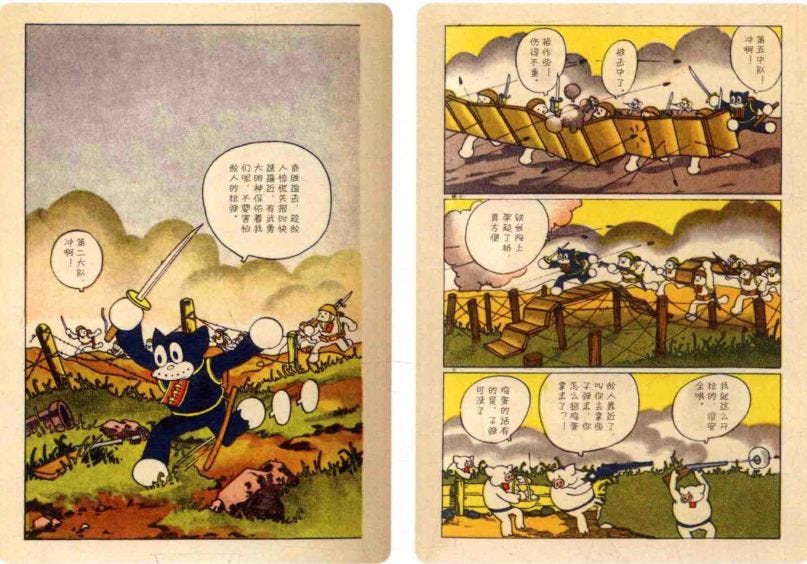
The real breakthrough for Shonen Kurabu came in 1931, when they began including Norakuro in the magazine, a manga series starring an anthropomorphic dog who served in the Fierce Dogs Regiment. Throughout the series, the main character, Norakuro, rises through the ranks of the dog army whilst fighting the pig army from the continent. The propaganda in this story seeks to influence readers in every possible way. Firstly, and structurally, the protagonist embodies the Japanese ideal: effort and dedication to serve the homeland and thus emerge as a war hero. The enemy army is situated on the Asian mainland, which allows for a quick association with the Chinese Army that Japan had been facing since the invasion of Manchuria in 1931. The characterisation of the enemies as pigs establishes a marked difference between the Japanese and the Chinese, which is nothing more than a representation for a young audience of the sense of cultural superiority that the Government had imposed in the Empire of Japan.
The manga’s success in Japan was accompanied by the success of its animated version, the anime. This format faced significant competition from animated films imported from the West in the 1920s and 1930s, which surpassed domestic productions in both quality and price. The only way anime could establish itself was by exploring themes closer to Japanese society. This was key to getting adults to identify with the content and choose to take their children to the cinema to watch these films, which leaned into cultural references and aimed, in one way or another, to preserve the values of the Japanese nation.
In 1939, with the ban on the screening of foreign films, Japanese anime experienced its first golden age. This was accompanied by educational shorts featuring the very same characters that dominated the cinemas, which helped children themselves ask their parents to take them to see the films, allowing the propaganda to take deeper root. The most iconic anime of this period was released in 1943: Momotarō no Umiwashi5. Momotarō, the protagonist of this children’s film, is a figure from Japanese folklore with whom parents and children were already very familiar.
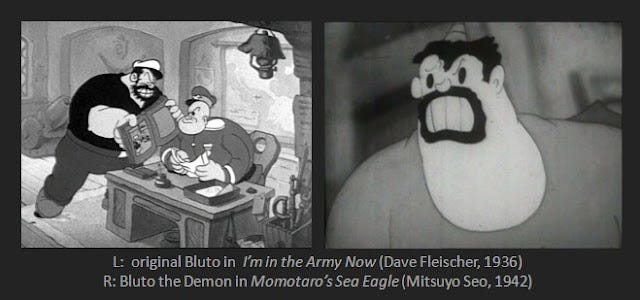
The story tells how this character is joined by a group of animals on a mission to destroy Demon Island, whose inhabitants were portrayed as Americans and British. To make it more credible, the depiction of many of the island’s inhabitants followed the patterns of American animated characters with whom the audience was familiar thanks to years of watching such films. This is the case with the appearance of Brutus, Popeye’s antagonist, as an enemy soldier who abused alcohol and lacked any discipline. In itself, the entire film is a clear reference to Pearl Harbor and a justification of the Japanese Army’s actions aimed at the broader public.
This film had a sequel, Momotarō - Umi no Shinpei6, which was released in 1945, a few months before the end of the war. This work is the first feature-length anime and, alongside its predecessor, a masterpiece of Japanese propaganda from this period. On this occasion, the protagonist travels to the island of Celebes, which during the war went from being a Dutch colony to being occupied by the Empire of Japan. Momotarō, portrayed as a general in the Japanese Army, arrives on the island accompanied by his animal friends and encounters a population of animals living in extreme poverty. The narrative conveyed by the film portrays Japan as the Empire acting to liberate all of Asia and capable of bringing progress to the rest of the regions. Through all this, the anime reinforces the Pan-Asian ideal that Japan used to justify the invasion of numerous countries in continental Asia and the Pacific.
By popular demand, here’s a button for procrastinating, in case you have plenty of things to do, but you don’t feel like. Each time you click on it, it will take you to a different map from the more than 1,200 in the catalogue.
If you like what you read, don’t hesitate to subscribe to receive an email with each new article that is published.
There are numerous articles and essays on this subject, but depending on what you’re looking for, you may find one that supports your viewpoint. Personally, I find one published in 1935 by Carroll H. Wooddy particularly interesting, mainly because it helps to understand that almost 90 years ago there were already people concerned about this issue. It should be noted that almost everything he says is highly questionable by today’s social standards.
You can read the full text on the David Rumsey website.
In Japan, all emperors were legitimate heirs of the legendary Emperor Jinmu Tennō, whom mythology identifies as a direct descendant of Amaterasu, the Sun Goddess. All of Jinmu’s successors, according to the traditional order of succession, automatically became descendants of Amaterasu. Even the 1889 Constitution affirmed the divinity of the imperial family, a belief that persisted until Hirohito’s reign during the Second World War.
Although I mention only the example of Nazi Germany, the use of the Theory of Evolution in this sense is something that extends to many other powers. Moreover, eugenic ideas have transcended the authoritarian regimes of the first half of the 20th century and have been present in many other countries (including democratic ones) during the second half of the 20th century.
Momotarō’s Sea Eagles.
Momotarō: Sacred Sailors