


In February 2009, it had been barely five months since I’d left my first job1. I decided to pay a visit to some friends I’d left behind there, making the most of the fact that I had a day off, and they were all working. My new job had me travelling all day, so although we kept in touch by phone and email, there weren’t many opportunities for us to get together.
As always, we caught up. We talked about mundane things like work, but also about some life changes that some of them had in mind. That was when C. told us that his sister was getting married in August, and that he was keen to return to Lebanon to celebrate it. What’s more, the family also wanted us to accompany them to the wedding. C. and his family had arrived in Spain in early 2007, and from the first day they were extraordinarily hospitable people, eager to share and to learn. None of us were surprised by the invitation and, after giving it very little thought2, three of us accepted.
I’ve never been a particularly indecisive person, and there have been countless times when I’ve made decisions without studying everything in detail. This is especially common when it comes to travelling. That trip to Lebanon was yet another example. I remember we were exploring different options and combinations to make the trip even more interesting. One option was to take the opportunity to visit Syria, although we eventually opted for Jordan, mainly because Petra was very much on everyone’s mind. I must confess that I have often thought back on this decision, as there will be no other chance to visit the Syria I could have visited3.
After four or five days in Jordan, we arrived in Lebanon on 11 August, and I discovered a world for which I was absolutely unprepared.
A country that doesn’t fit on the map
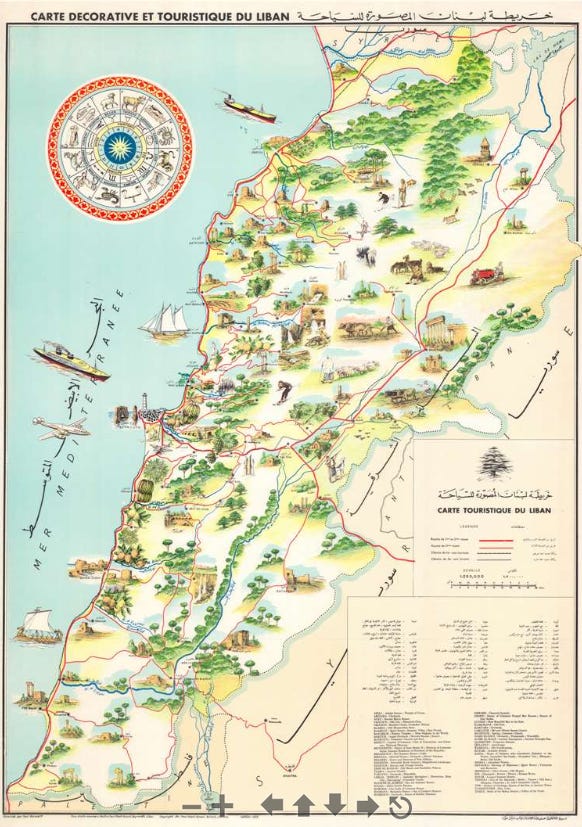
Lebanon is a country of relatively small size. Covering some 10,000 square kilometres, it is smaller than Connecticut (United States) or Cyprus, yet it has a population of over five million. All of them crammed in, with the Mediterranean Sea to the west, Syria to the north and east, and Israel to the south. A territory that is also home to a rich history of the peoples who shaped it, such as the Phoenicians, Persians, Greeks, Romans, Arabs, Crusaders, Ottomans, and French4.
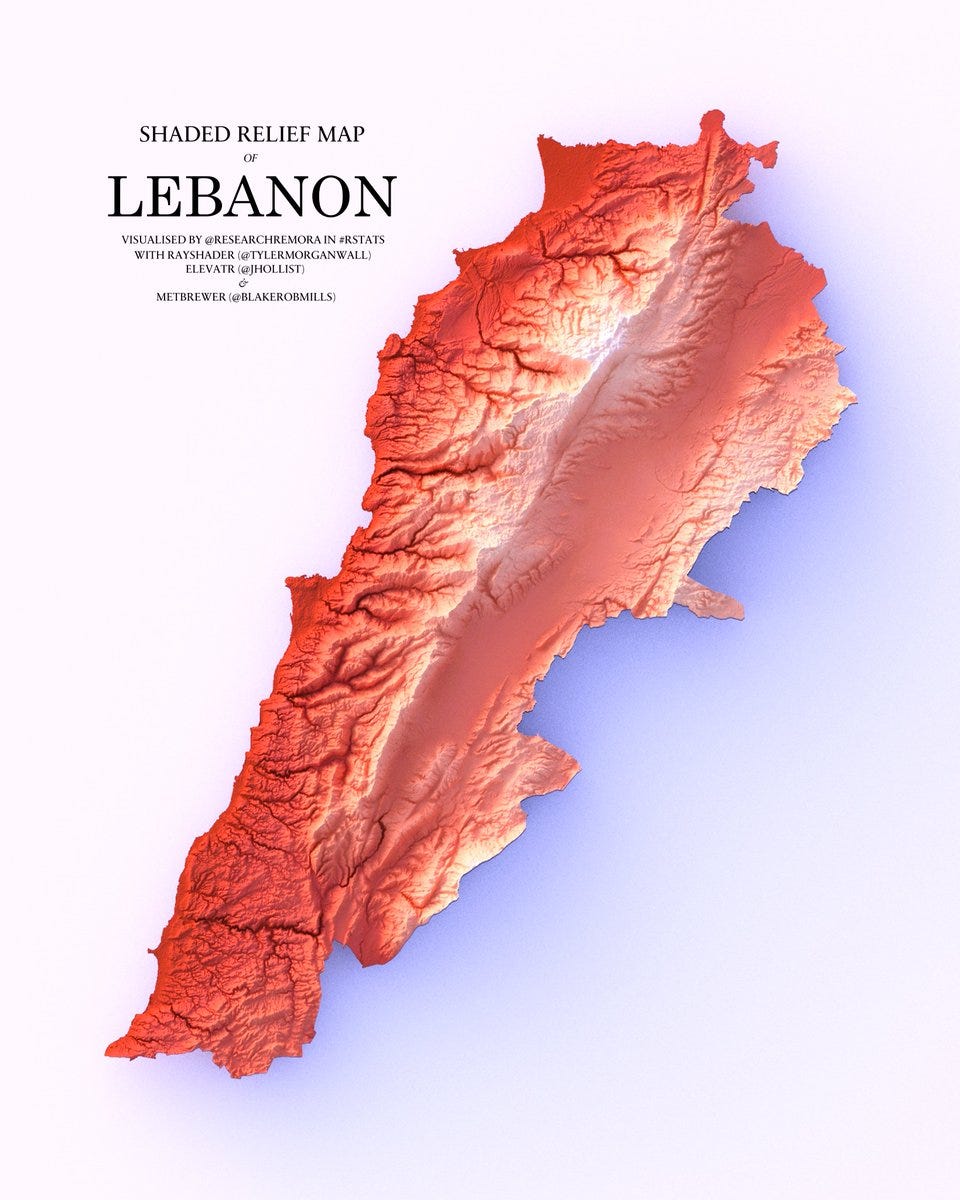
You might think that, with so many inhabitants and so little territory, the landscape would be relatively flat and fertile, but nothing could be further from the truth. The mountains of Lebanon reach an altitude of 3,000 metres, less than 30 kilometres from the coast, behind which lies the fertile Beqaa Valley, separated from Syria only by the Anti-Lebanon mountain range. This terrain creates a diversity of landscapes that includes Mediterranean coast, alpine ski resorts, semi-arid steppe, and fertile agricultural valleys, all within a two-hour drive of each other. And beneath those mountains lies one of the most coveted treasures in the entire Middle East: the region’s largest freshwater reserve.
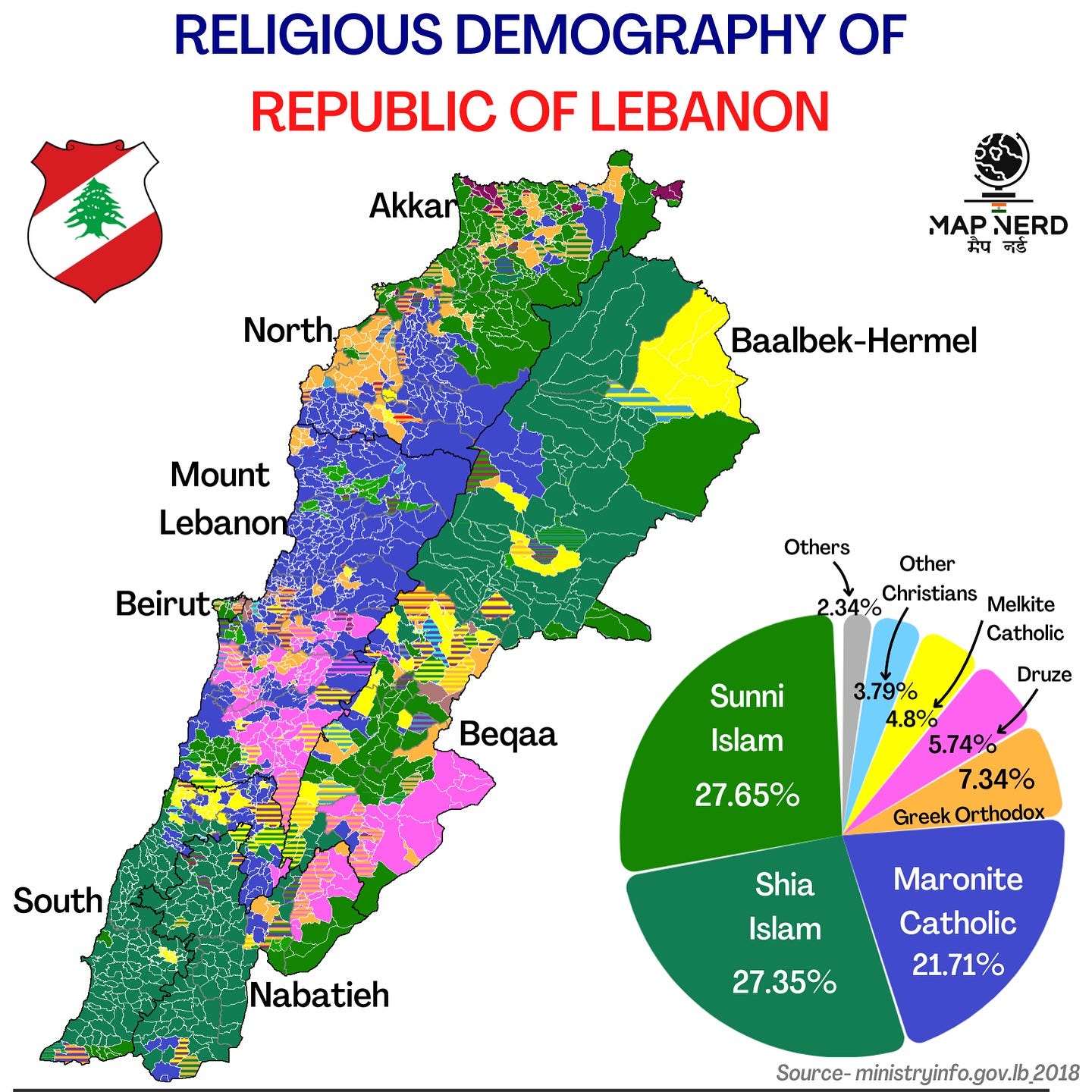
This geography is merely the first level of complexity; the second is religious. Officially, Lebanon recognises eighteen different religious denominations, including Shia, Sunni, Druze, Alawite, Maronite, Greek Orthodox, Greek Catholic, Armenian and even a small Jewish community. It is known that all these denominations are active, but since the census carried out under French control in 1932, no further census has been conducted. The reason may seem surprising, but it is indicative of the country’s fragile political balance.
Following Lebanon’s independence in 1943, the country’s leaders established an unwritten agreement popularly known as the National Pact: the President of the Republic would always be a Maronite Christian, the Prime Minister a Sunni Muslim and the Speaker of Parliament a Shia Muslim. This arrangement ensured that none of the major religious groups would be excluded from power, but it also established a distinct religious identity. This pact survived the 15-year civil war, as the Taif Agreement, signed in 1989, consolidated this division of power with a slight adjustment to the respective powers, an agreement that remains in place to this day5 and which, were a new religious census to be carried out, could be overturned after more than 80 years of democracy and coexistence.
All of that is what is written on paper, but the reality on the streets is slightly different. I remember perfectly well walking through Beirut and seeing a woman in a low-cut top and another in a hijab chatting away, or a mosque just a few metres away from a church. It didn’t seem as though the existence of the other building mattered in the slightest to anyone. It didn’t feel as though coexistence was forced by the country’s constitution, but rather that it felt genuinely authentic. Of course, there were neighbourhoods and areas where certain faiths predominated over others, but that did not seem to exclude anyone. Lebanon’s conflicts throughout history have almost always derived from foreign interference or problems at the highest levels. Ordinary people coexist and are neighbours, in a sort of functional indifference6.
Lebanon’s aspirations are also important for a deeper understanding of the country. Between the 1950s and the 1970s, the inhabitants of Beirut liked to refer to their city as the Paris of the Middle East. They were not seeking easy tourism and money, but rather a project of identity. Beirut was the most cosmopolitan city in the entire Middle East, with prestigious universities, multinational companies operating there and a nightlife that attracted Arabs and Europeans alike. Beirut had what few other capitals in the region could offer: a free press, miniskirts, and minarets on the same avenue, Lebanese wine on the Mediterranean beach and mountain skiing less than an hour away. A country where things coexisted that were incompatible elsewhere in the Arab world.
And, well, it lasted as long as it did.
In 1975, a civil war broke out that lasted fifteen years. Then came an attempt at reconstruction, which, after another fifteen years, was cut short by the 2006 war with Israel. And with all that, in August 2009, I arrived with two friends at Beirut airport without knowing much about what to expect.
The Lebanon I experienced
My older sister had been insisting for weeks beforehand that I shouldn’t go, and, as I’ve done practically all my life, I didn’t pay her much heed. I adore my sister, but her perception of danger has always been exaggerated, though that doesn’t mean mine wasn’t slightly limited at the time. I don’t think I had a real sense of what I was getting myself into until we arrived at Amman airport to catch the flight to Beirut. There we had to go through multiple passport checks, as is the case at airports, though with the major difference that they checked every page of our passports up to three times. The last official also asked us directly what they were looking for: whether we had visited Israel recently. If the answer was yes, entry into Lebanon was strictly prohibited7.
C. picked us up at the airport, and we began the journey to his town, Zahlé, in the Beqaa Valley. It was during that journey that the reality really hit home. A journey that should have taken barely an hour stretched to almost two hours. It was mainly because we had to travel along a multitude of secondary roads, as many of the bridges of the main road had been destroyed three years ago, and they were not yet rebuilt8. Furthermore, I was also surprised by the number of army checkpoints along the road, although we quickly realised this was quite routine.
Finally, we arrived at our destination.
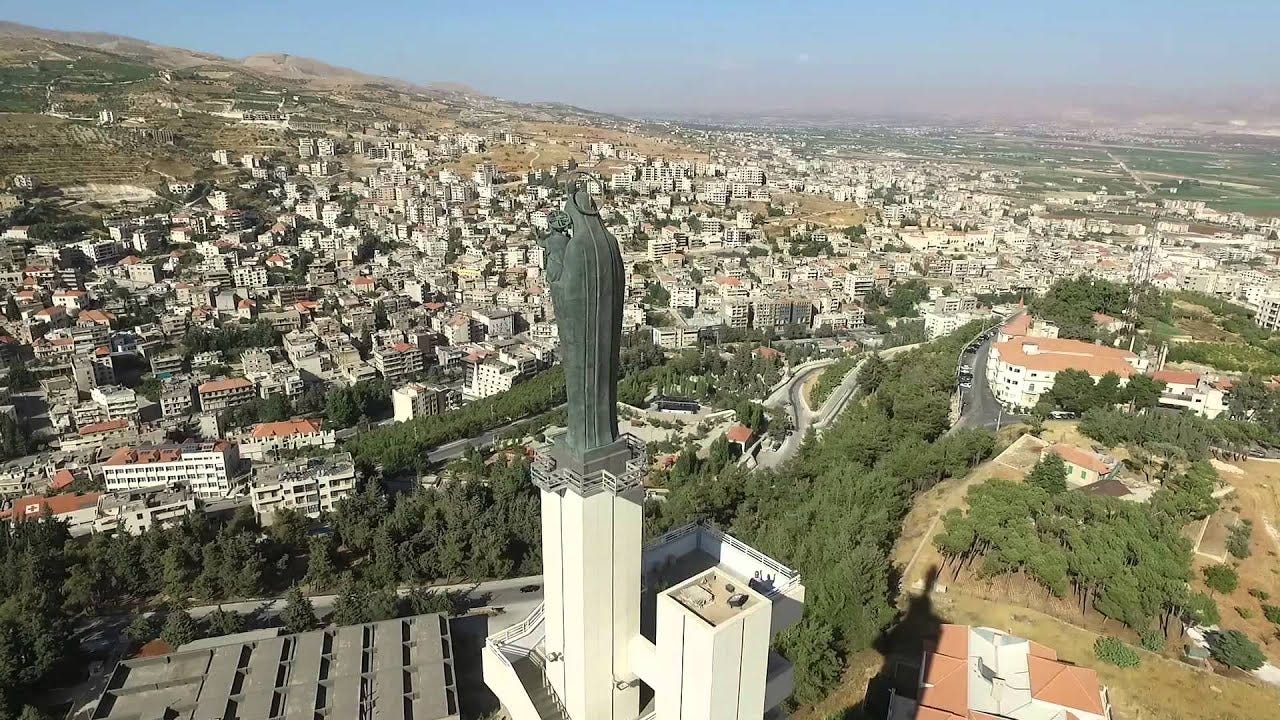
Zahlé is a perfect example of Lebanon’s diversity. It is home to Lebanon’s largest Catholic community, dominated by a 10-metre-tall bronze statue of the Virgin Mary, standing on a 54-metre-high concrete platform on one of the city’s hills. There I discovered that, unlike in Jordan, you could have a beer in any café without a problem, and that you could enjoy the region’s typical wine. C.’s family gave us a wonderful welcome and introduced us to the extended family, where I saw once again that human concerns easily transcend cultural boundaries.
And the wedding. What a wedding! I don’t know how many of you have had the chance to attend weddings in cultures different from your own, but it’s an experience you shouldn’t miss if you get the chance. It was three days of celebration and tradition completely unconnected to everything I knew and, perhaps for that very reason, fascinating. Although the wedding was Catholic, the tradition in Zahlé is nothing like what I learnt in my teenage years in Catholic Spain. It incorporated many elements of Orthodox traditions, such as the absence of statues in the churches, the use of crowns during the ceremony, or the bride and groom circling the altar three times whilst dancing9.
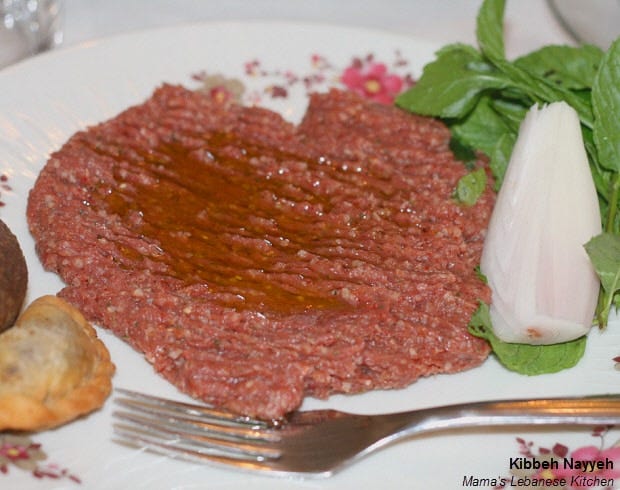
Then came the reception, which was more like a fancy party. There was live music, and even a sort of performance. Meanwhile, we were able to chat, to dance and, the most important of all, to eat. The food was absolutely marvellous. I’m sure many of you have tried Lebanese food in an international restaurant, but the culinary variety goes far beyond what a restaurant abroad can offer10.
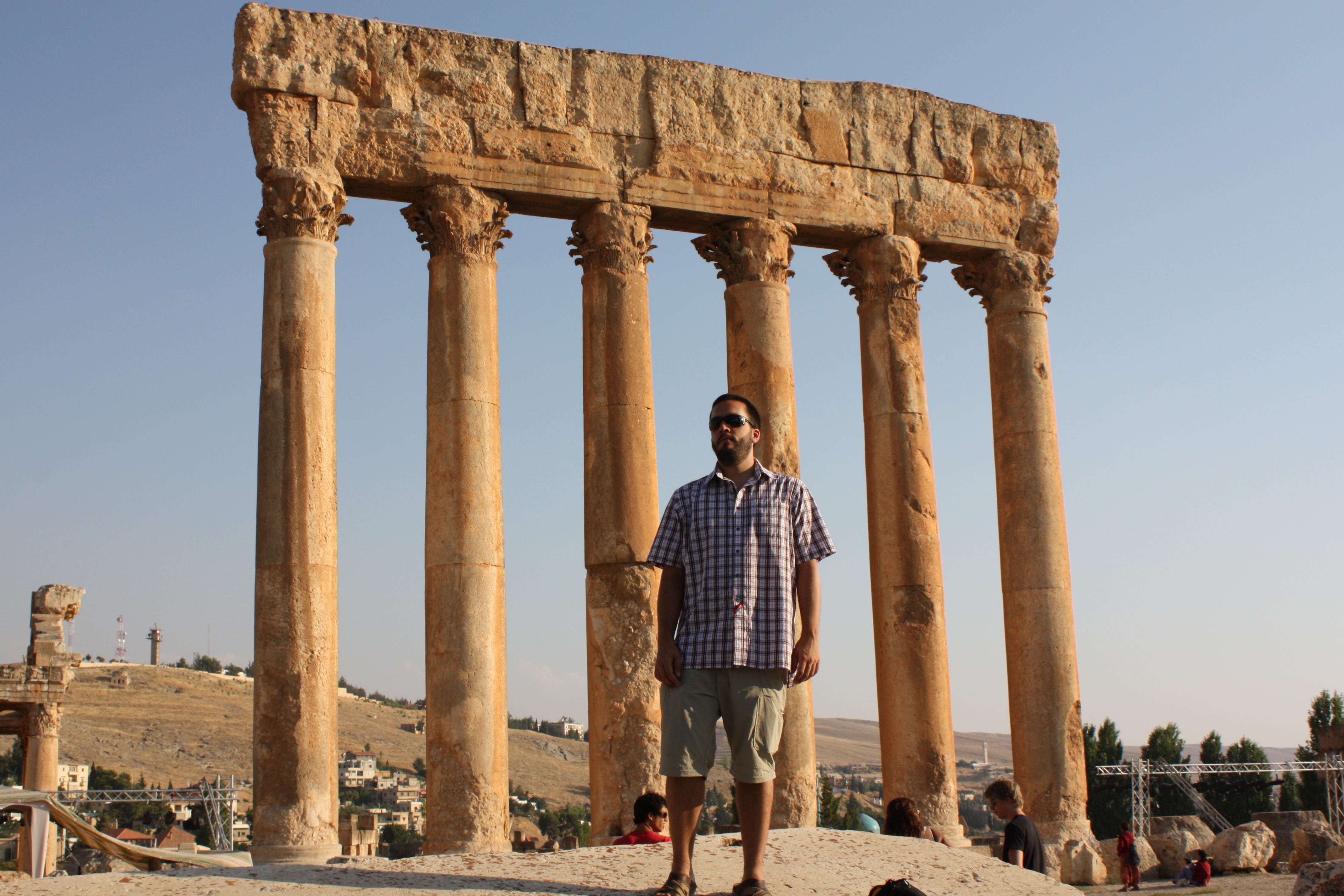
Of course, the three of us, the Spanish visitors, were keen to do some sightseeing, as it was our first time in Lebanon. Everyone recommended we visit Baalbek, though they insisted we go with someone, so C. came along with us. In Baalbek, 40 kilometres north of Zahlé, lie some of the best-preserved Roman ruins in the whole of the Middle East. The area is rural and there were hardly any tourists, so we parked in front of the entrance and C. went to buy the tickets.
I remember perfectly a strange sight that caught the attention of the three of us as we waited. It was a civilian walking around the area, talking to various people and to all the police officers around the ruins. Somehow, we sensed that this civilian was controlling the situation, although at the time we couldn’t quite grasp exactly what was going on. C. returned with the tickets and explained that the man was a member of Hezbollah, the group controlling that region. But he also told us not to worry, as the areas controlled by Hezbollah were, by far, the safest11.
Over the following days, we also took the opportunity to visit the coast. I was fascinated by the Jeita Grotto, a vast cave system that allows you to see the mountains’ impressive freshwater reserves at first hand. From there we went to the Mediterranean beach which, despite being far away, still had something about it that made it feel familiar. I also enjoyed having a quiet dinner in the streets of Byblos, a city steeped in history that you can still feel in its walls. And Beirut, a unique city. It may never have quite become the Paris of the Middle East, but it certainly has a special and unique character. I spent one of the best nights out of my life there12.
The only regret I was left with was not being able to visit a cedar forest. My plan had been to spend a day walking through one of those cedar forests in the southern Beqaa Valley, but when we mentioned it to C.’s father, he put a stop to it straight away: not to even think about it, as it was far too dangerous. We didn’t press the matter.
The trip came to an end. C. took us to the airport, and we returned to Spain, the three of us intending to go back to Lebanon at some point.
What came next
Time passes and relationships cool off. It’s something I’ve come to understand over the years and have learnt to live with. It’s not that anything in particular happened, but lives drift in different directions, all the more so when we’re all constantly travelling for work and don’t even live in the same country at weekends. That idea of returning to Lebanon became increasingly distant, and the fact that there was a civil war on the Syrian border, with millions of refugees moving through the region, didn’t exactly encourage us either.
Then came August 2020. A massive explosion in the port of Beirut dominated the front pages of all the international newspapers. When I saw the news, I contacted C. to find out how he and his family were. C. had been living in the United States for years, but his sister had suffered the direct consequences of the explosion, as the windows of her house in Beirut, in another part of the city, had been completely shattered. Fortunately, no one in his family was among the hundreds of victims of the incident.
Then came October 2023. Israel entered Gaza, and Hezbollah decided to open a front in the north to support Hamas from southern Lebanon. Since then, things have only got worse. What began as limited exchanges of fire ended with a new Israeli invasion in the autumn of 2024. A ceasefire was eventually signed, but never true peace.
Last February, the US and Israeli attack on Iran reignited the conflict. Hezbollah responded once again, and Israel once more destroyed all the bridges that had taken so much effort to rebuild. More than a million people have had to flee their homes in the south of the country, whilst everyone awaits an Israeli ground invasion.
The idea of returning to Lebanon feels further away than ever. And coming from someone who has been putting off the trip for years, that’s saying a lot.
By popular demand, here’s a button for procrastinating, in case you have plenty of things to do, but you don’t feel like. Each time you click on it, it will take you to a different map from the more than 1,200 in the catalogue.
If you like what you read, don’t hesitate to subscribe to receive an email with each new article that is published.
And now I’m in my second job. I’m not someone who’s changed jobs very often, to be honest.
I was 27; now I’m 44. The age difference is relevant to understand the story today.
I don’t regret the decision because I’m someone who refuses regret. Judging past decisions by their outcomes is cheating at solitaire.
Lebanon’s history is encyclopaedic, so it’s pointless to try to go into detail about everything today. That said, I do want to note here that Tyre, Byblos and Sidon were all located in what is now Lebanon.
This also has a significant impact on Lebanese political life. Almost all the parties that have been of any significance in the country have been associated with different religious denominations, as parliament has had to be divided equally between Christians and Muslims since the Taif Agreement. In fact, whenever someone stands for a constituency in parliamentary elections, they are required to declare a religious denomination, even if their party is non-denominational, to ensure they maintain the balance.
I once heard the term ‘functional indifference’ used to describe coexistence in Lebanon, and I think it’s a very precise description.
Technically, Lebanon was still at war with Israel.
During the 33-day war between Israel and Lebanon, 73 bridges were destroyed in Lebanon. The vast majority were in the south, but the Mudeirej Bridge (the highest in the country) was also destroyed; it stood on the motorway linking Beirut with Damascus. And that was precisely the same motorway one had to take to reach Zahlé.
Over the years, I have learnt that all this is quite common among Eastern Catholics of the Byzantine rite, who are precisely the Catholics of Lebanon.
Here I wish to clarify an important point. C. and his family were not just any family in Lebanon. They weren’t rich, but they certainly had the luxury of belonging to the upper class. Not all Lebanese could afford a wedding like that back then, although weddings in general are definitely more ostentatious than in Spain.
When in Rome, do as the Romans do. We didn’t ask any more questions on the subject.
Although I’ve lost my touch, back then I could still make comparisons.
Lovely tribute to such a great, beautiful and suffering country. Thank you.