

Christmas and Kim Jong-suk’s birthday
A tour of multiple winter solstice celebrations and traditions around the world.

Today is Christmas, one of humanity’s most international celebrations. As such, it is a public holiday in most of the world and for practically everyone reading this today. Among English-speaking countries, there is not a single one where it is not a public holiday, and among Spanish-speaking countries, only Uruguay does not celebrate Christmas.
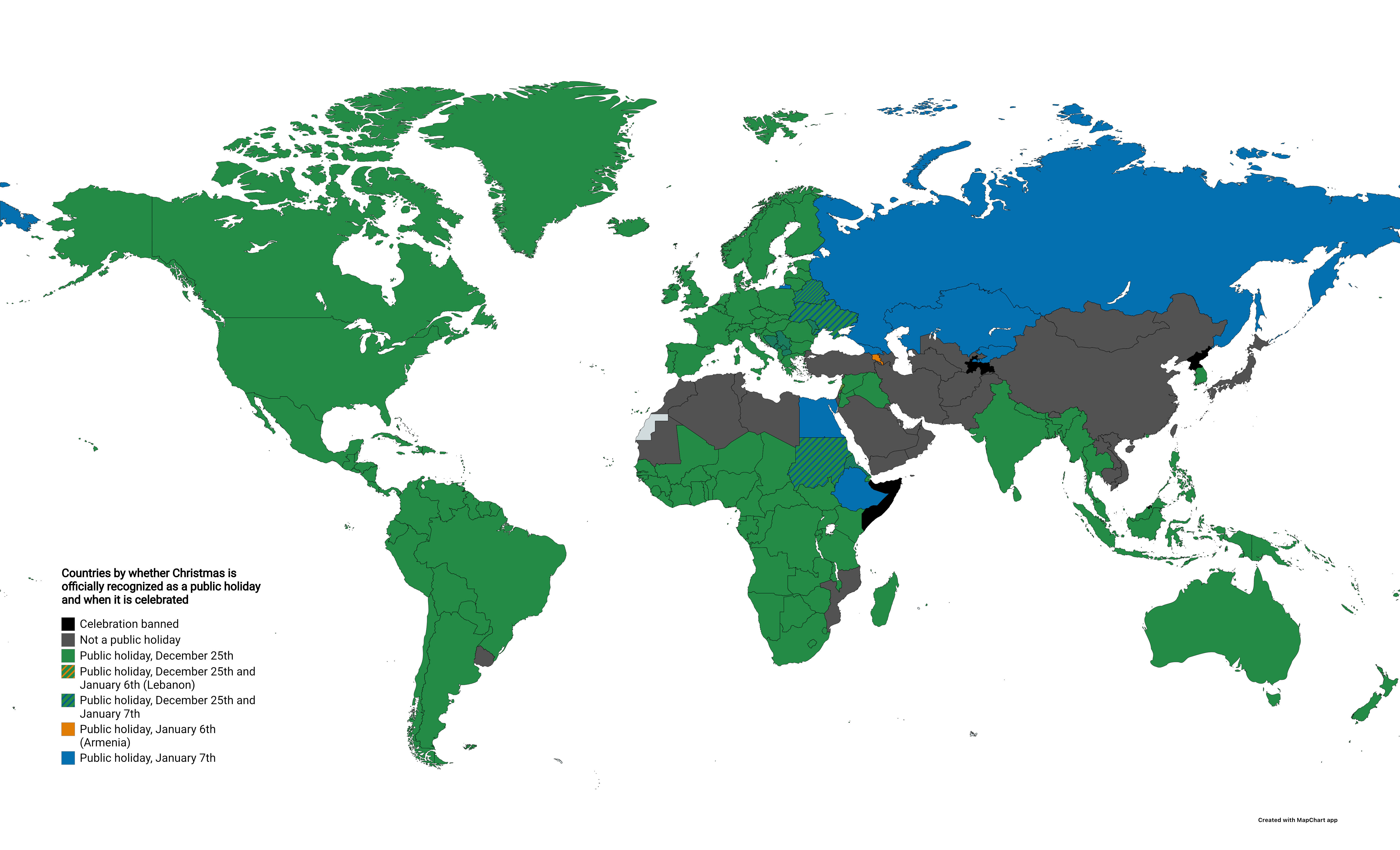
Although Christmas is not celebrated as such, today, 25 December, is also a public holiday in Uruguay, but for more than 100 years it has been known as Día de la Familia1. This is one of the consequences of the separation of church and state that took place in Uruguay between the late 19th and early 20th centuries. The measure, promoted in 1919 by the government of José Batlle y Ordóñez, was not intended as an attack on the religiosity of citizens, but rather sought to secularise the country completely2. This did not prevent the tradition of gathering on 25 December from continuing, but it did make it easier for each household to label the holiday as they wished.
Changes such as those in Uruguay have been repeated many times throughout history. In North Korea, this was taken to the extreme and, to limit Western influence, the celebration of Christmas was explicitly banned in 1948, following the founding of the communist state. That same year, the celebration of the winter solstice was established on 20 December3 and, two years later, the birthday of Kim Jong-suk, Kim Jong-un’s grandmother, on 24 December4.
The celebration of Christmas on 25 December itself has a history similar to that of Kim Jong-suk’s birthday. The commemoration of the birth of Jesus Christ has been attested in Christian records since the 2nd century, but in no case with a specific and consistent date. Everything points to Pope Julius I establishing the date as 25 December5, the very day on which the birth of Sol Invictus was celebrated in Rome at that time. Both Christmas and the Dies Natalis Solis Invicti were festivities promoted to assimilate the pagan festival of Saturnalia, during which the Romans celebrated the winter solstice.
Overall, it all comes down to that, the winter solstice and how to label it.
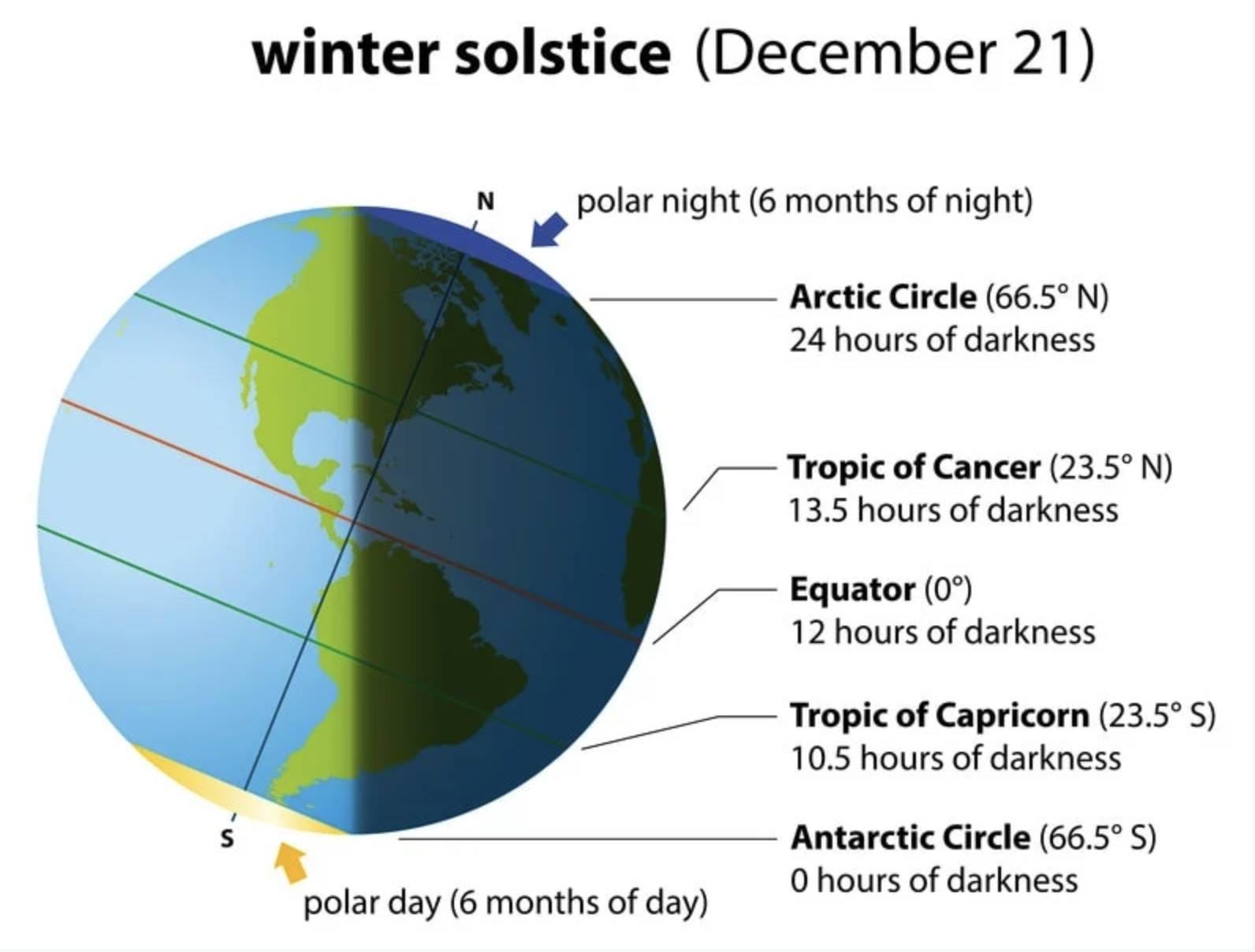
Since the first human groups went from being nomadic to sedentary, the calendar became of great importance. It was essential to know the annual cycles to get the most out of agriculture and livestock farming. This is how the extreme days, when the days or nights were longest, the solstices, began to gain importance and be celebrated consistently. Just as the Romans celebrated Saturnalia, many other peoples had similar celebrations around the world.
The Anglo-Saxons celebrated the night of the mothers, Modranicht. The Germanic peoples celebrated Yule, a festival from which we have inherited mistletoe. Further north, in Lapland, the Sami celebrated the return of Beiwe, the sun goddess, who brought back green pastures for the reindeer. The longest night, Yaldā Night, is still celebrated in Iran, Kurdistan, Azerbaijan, and Tajikistan. On this day, families gather to read poetry until after midnight, while eating pomegranates and watermelon, whose red colour is reminiscent of dawn and the return to life.
In the Southern Hemisphere, these festivities were also common at the end of June, when the southern winter solstice occurs in this half of the world. In the Andes, long before the arrival of the Spanish conquistadors, the pre-Inca peoples already celebrated Inti Raymi, the day when the sun god, Inti, was reborn and the new annual cycle began. The Aymara people also celebrate the new year during the southern winter solstice, Willkakuti, to commemorate the return of the sun.
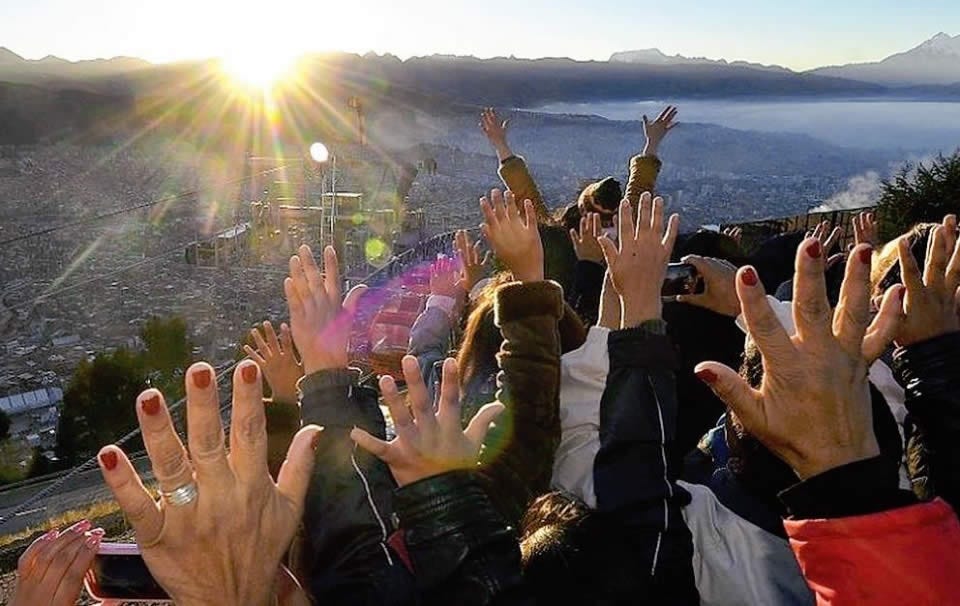
Social gatherings and the sun seem to be the general pattern for all winter solstice celebrations. And, personally, for me, these are also two things to celebrate. The days are finally not so short any more, and I can also take advantage of this time of year to see many people I don’t get to see at other times of the year. What I find much harder to deal with is the other pillar on which Christmas has been based in recent decades: the exchange of gifts. Not only because I never know what to give, but also because of the consumerism into which insatiable capitalism has plunged us.
Nowadays, Santa Claus is massive almost everywhere in the world. His omnipresence can be annoying, but we have to admit that his background story is very fascinating. The character is a direct descendant of the Christian tradition of Saint Nicholas6, but his appearance is closer to the English tradition of Father Christmas, the personification of Christmas cheer. As many of you know, we owe this image to Haddon Sundblom, who drew Santa Claus for Coca-Cola in the Christmas of 1931. He was not the first to do so, but until the Coca-Cola campaign, there was no consensus on the colour of his clothing.
Before Father Christmas, gifts were brought by many other characters from different folk traditions. In Europe, this diversity is still preserved in many countries.
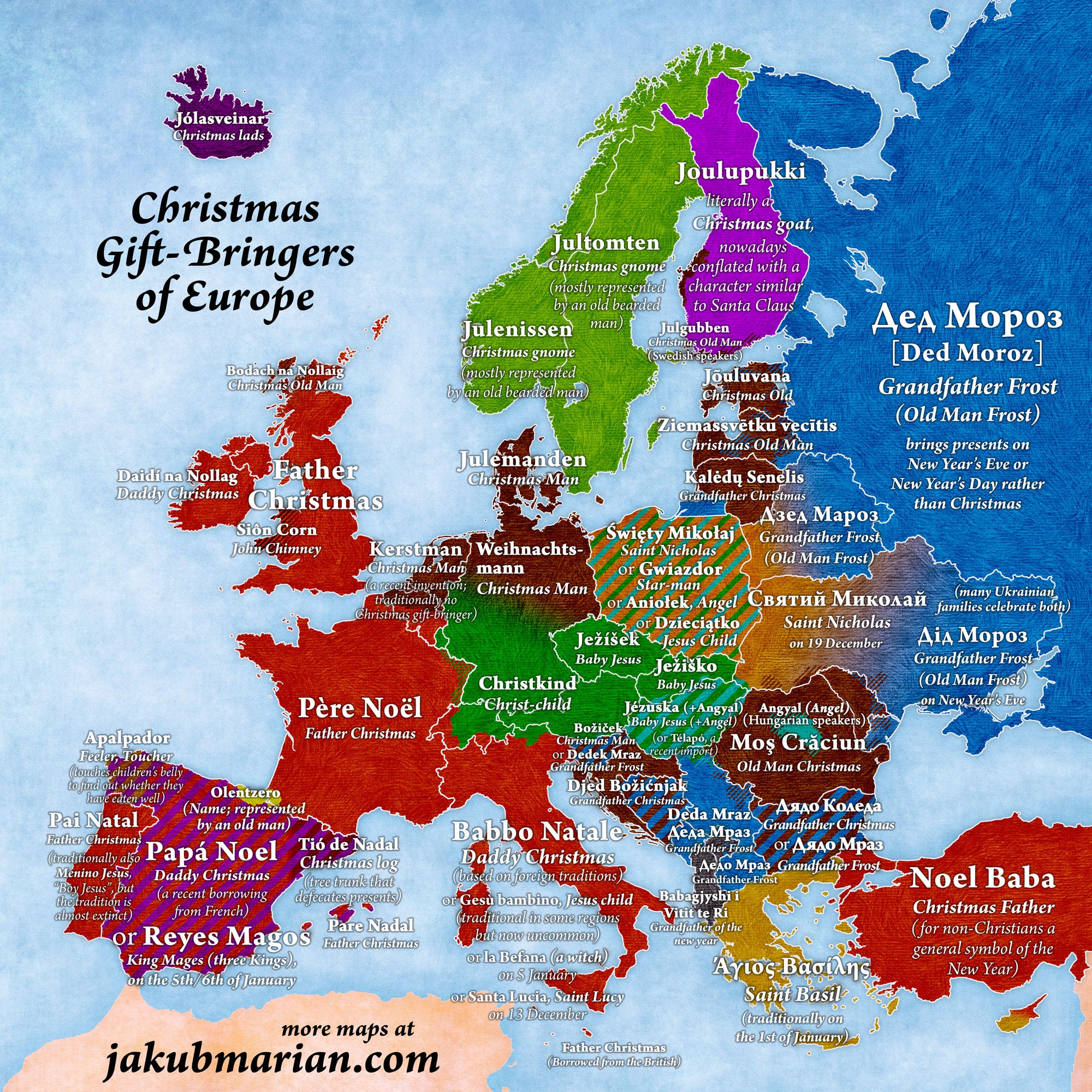
Many of these characters have their origins in the Christian tradition of Saint Nicholas, although they have been adapted to the cultural traditions of different regions. This is the case of Ded Moroz7, the grandfather of ice, who knocks on the doors of Slavic homes asking children to sing if they want to receive their gifts. In Scandinavia, a gnome with white hair and beard, named Nisse, suspiciously similar to Nicholas, is responsible for spreading joy among the youngest.
In Spain, and in part of Latin America, the Three Wise Men still deliver gifts on 6 January, in fierce competition with Santa Claus. This battle is fought in many homes in the Basque Country, where Olentzero comes down from the mountains with his gifts, or in Catalonia and Aragon, where tió dispatches gifts while children beat him. Befana still visits some homes in Italy. The angels who accompany the Baby Jesus are in charge in some regions of Hungary and Poland, and the Baby Jesus himself is in charge in much of Europe and Latin America.
Whatever your tradition is for these days, have the best time you can. Enjoy being with your loved ones, going out to party, reading a book or sleeping a little longer than usual.
Happy birthday, Kim Jong-suk!
By popular demand, here’s a button for procrastinating, in case you have plenty of things to do, but you don’t feel like. Each time you click on it, it will take you to a different map from the more than 1,100 in the catalogue.
If you like what you read, don’t hesitate to subscribe to receive an email with each new article that is published.
Family Day.
Another example of this is the celebration of Holy Week, which in Uruguay became Tourism Week.
Kim Jong-suk died in 1949, and her birthday began to be celebrated a year after her death as a revolutionary holiday alternative to Christmas.
The first document to record this date is the Calendar of Filocalus, which dates back to 354 AD.
St. Nicholas is celebrated on 5 December, which is when gifts were distributed during the Middle Ages. With the Lutheran Reformation and the need to eradicate saints, the exchange of gifts moved to Christmas Day in Protestant Europe.
The Soviet Union was instrumental in replacing Santa Claus with Ded Moroz in an attempt to break away from Western culture and reclaim its own roots.
Uruguay is a secular state and does not celebrate religious holidays, but December 25 is a national holiday because the Uruguayan state celebrates Family Day. As it could be otherwise, on the holiday of December 25, every Uruguayan in his house celebrates what he wants.